

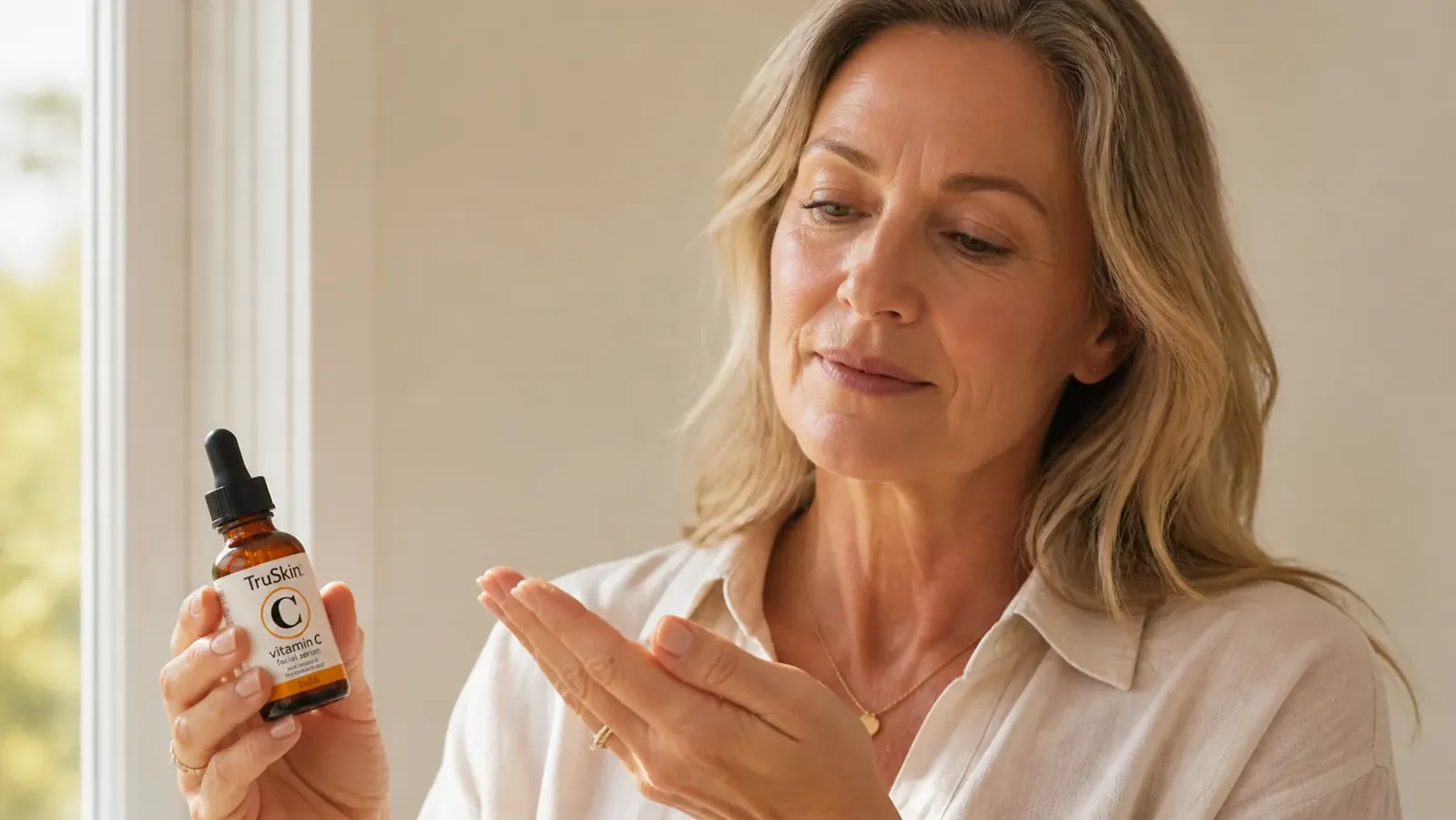
There are 155,000 reviews of TruSkin Vitamin C Serum on Amazon. That is a meaningful number, and I do not want to dismiss it. But when I spent an afternoon reading through several hundred of them, something became clear: the people writing those reviews are largely in their twenties and thirties, treating acne marks, early sun spots, and the kind of skin that still has significant reserves of collagen and elastin to work with. Their experience of this serum is real. It is just not my experience, or yours, if you are reading this at fifty-three or fifty-eight or sixty-one with skin that has been through the hormonal shift and come out the other side noticeably different.
I have used TruSkin Vitamin C Serum. I have also spent time with its formulation chemistry, talked to women in this age group who have tried it, and thought about why the things most reviewers praise are sometimes the things that matter least on mature skin. This article is about what the standard review leaves out. It is not a takedown. The serum is genuinely useful. But useful for whom, under what conditions, and with what expectations, are the questions the star rating cannot answer.
The Quick Verdict
A legitimate serum with real brightening activity, but the mass-market hype around concentration and the L-ascorbic plus hyaluronic pairing conceals real limitations for post-menopausal skin.
Amazon Check Today's Price →Still the right serum for many women over 50, but only if you go in knowing what it can and cannot do.
TruSkin Vitamin C Serum is available on Amazon. If you have read this far, you will use it more effectively than most buyers. Check current availability before the next price adjustment.
Amazon Check Today's Price on Amazon →The 20% Vitamin C Myth and Why It Keeps Getting Repeated
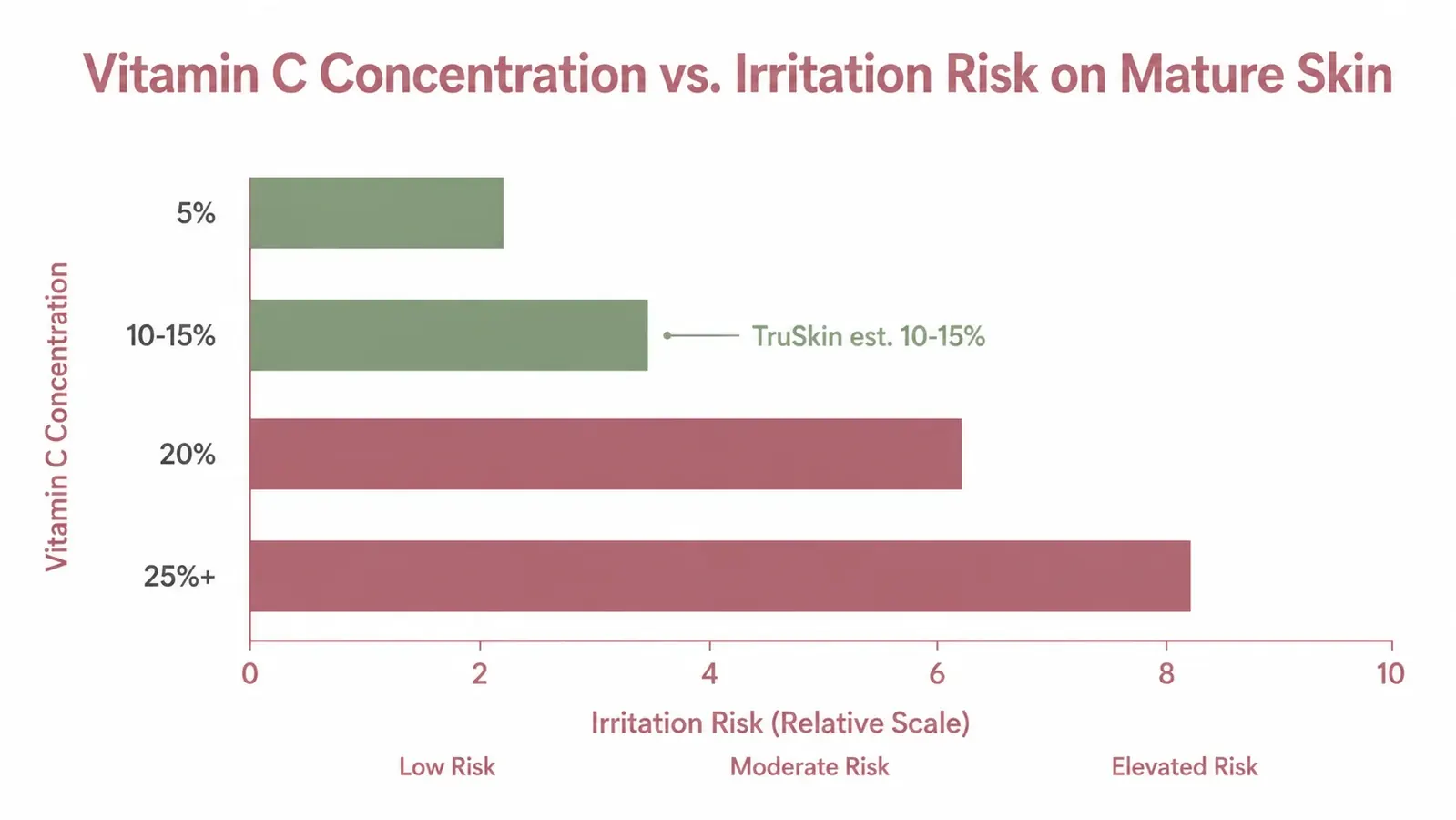
There is a belief in skincare communities, particularly among younger enthusiasts, that higher vitamin C concentrations produce better results. You see it in the language around serums: "20% L-ascorbic acid," stated as if it were a mark of quality the way thread count once was for sheets. The truth is more complicated, and for women over fifty, the complication matters a great deal.
L-ascorbic acid's relationship with the skin is pH-dependent. It needs an acidic environment, roughly below 3.5, to penetrate the skin barrier effectively. At concentrations above fifteen percent, getting it to absorb requires a pH low enough that it creates significant irritation on skin that has thinned and lost some of its barrier integrity after menopause. The research that established L-ascorbic acid's collagen-stimulating and brightening effects was conducted at concentrations between five and twenty percent, with the strongest evidence clustered around ten to fifteen. Adding more vitamin C does not linearly add more benefit. It adds more acid, which on mature skin means more likelihood of redness, sensitivity, and barrier disruption.
TruSkin does not disclose its L-ascorbic acid concentration, which is a legitimate frustration, but based on its pH and the mild initial tingle I and others have reported, it likely sits in the ten to fifteen percent range. That is the appropriate zone for mature skin. The problem is that the marketing around this product, and around vitamin C serums generally, has absorbed the "more is better" idea so thoroughly that some women dismiss this serum precisely because it is not a twenty percent formula. They would do better with it than with the higher-concentration alternative that would leave their post-menopausal skin irritated within a week.
The L-Ascorbic Acid and Hyaluronic Acid Pairing: Overhyped for Mature Skin
TruSkin's formula combines L-ascorbic acid with hyaluronic acid, and the marketing leans into this pairing as a kind of double benefit: brightness plus hydration in one step. It is a legitimate combination, and the hyaluronic acid does provide surface-level hydration. But there is a specific limitation worth naming, and most reviews do not.
Hyaluronic acid works by attracting water molecules to the skin's surface. It is a humectant, not an emollient or occlusive. On younger skin with more intact barriers and higher ambient indoor humidity, this works well. On post-menopausal skin, which tends to have a compromised ceramide layer and reduced sebum production, hyaluronic acid applied without a sealing moisturizer on top can actually draw moisture out of deeper skin layers toward the surface and then into dry air, leaving skin feeling drier than before. This is a well-documented phenomenon, particularly in low-humidity environments or heated and air-conditioned rooms, which describes most offices and bedrooms in autumn and winter.
The fix is simple: always apply a moisturizer with emollient ingredients over this serum. Do not let it sit as a final step. But this is a meaningful caveat for women in this age group, and it is not one that the product page mentions. If you apply this serum and find your skin feels tight or drier than expected thirty minutes later, the hyaluronic acid without a seal is likely the cause, not an allergic reaction, not the vitamin C.
Hyaluronic acid without a sealing moisturizer over it can draw moisture out of post-menopausal skin rather than locking it in. This is a quiet flaw in the pairing nobody talks about.
The Bottle Design Problem Nobody Mentions
The packaging is a dark amber glass bottle with a pump dispenser. The dark glass is a genuine virtue: it slows oxidation by reducing UV exposure inside the bottle, which is real and helpful. But the pump has a design flaw that I have heard enough other women mention to believe it is consistent across batches, not a one-off defect.
The pump does not lock. It cannot be twisted to a closed position for travel. This means the bottle dispenses freely in a toiletry bag, and if the pump catches on anything, you lose a meaningful amount of an already-small bottle. At one fluid ounce, the bottle contains roughly forty to fifty pump applications if you use three to four drops per session, which is the recommended amount. That is a generous six to eight weeks of daily use if nothing goes wrong. It is considerably less if the pump catches on your makeup bag twice during a weekend trip.
There is also the issue of the pump dispensing more than you need. A gentle press delivers a larger amount than most users expect. The standard guidance is three to four drops, but the pump is not a dropper. Three pumps gives you more than three drops. This leads to either overapplication, which is not a safety concern but is wasteful with an already-modest volume, or a slightly awkward half-press technique that takes a few days to learn. None of this is disqualifying. It is worth knowing.
Oxidation and Scent Fatigue: Two Different Problems
Reviews mention the scent. What they rarely distinguish is that there are two separate scent phenomena with this serum, and they mean different things. Understanding which one you are experiencing is useful.
Fresh L-ascorbic acid has a mild, slightly sharp, faintly citrus-adjacent smell. This is normal, not a sign of a problem, and most people stop noticing it within a few days of daily use. That process has a name in sensory psychology: olfactory adaptation, sometimes called scent fatigue. Your nose habituates to a repeated stimulus and stops registering it. For some women, this happens by day three. For others it takes two weeks. If you find the scent noticeable at first, that does not mean the formula is off or that you should return it.
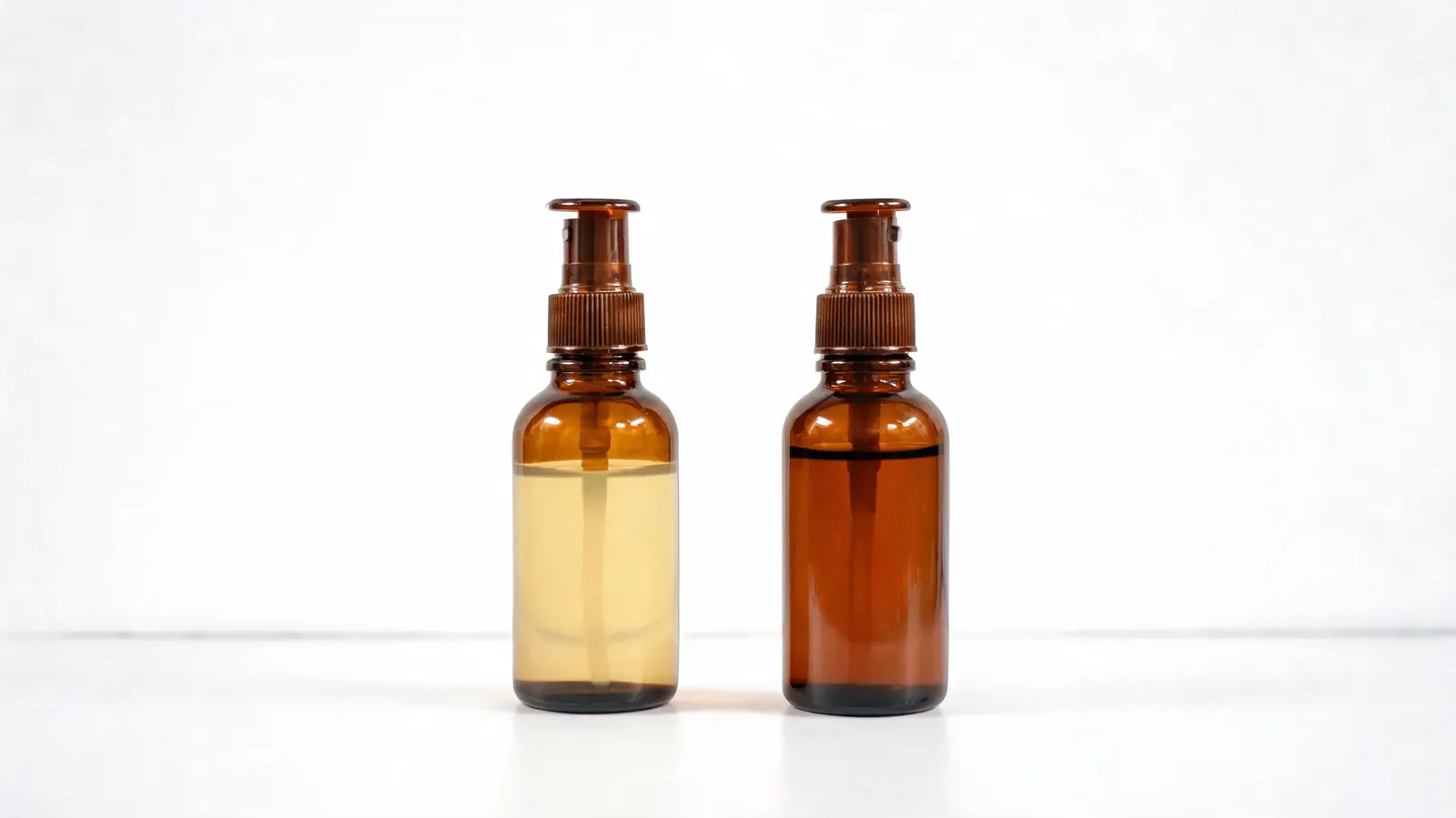
The second scent phenomenon is oxidation. An oxidized serum smells different: sharper, more metallic, slightly sour in a way that is distinct from the fresh citrus note. The color also shifts, from pale straw-yellow toward orange or amber-brown. These two things together, color change and changed scent, are the signal that the active ingredient has degraded and the serum will no longer deliver its brightening benefit. At that point, it is worth replacing the bottle even if product remains.
What I have noticed is that some women conflate these two scent experiences and assume oxidation early when what they are experiencing is simply the normal smell of the product they have not habituated to yet. And some women experience the reverse: they stop noticing the scent through habituation and miss the point at which the scent has genuinely changed to signal oxidation. Both errors are worth being aware of. Check the color, not just the smell. Pale yellow: fine. Orange-brown: time for a new bottle.
Who Should Not Use This Serum
Most vitamin C serum reviews end with a who-it's-for section that is really just a list of the reviewer's existing audience. Here is an attempt at something more specific.
If you have rosacea or persistently reactive skin, L-ascorbic acid at any concentration is worth approaching with real caution. The acidic pH required for it to work is a known trigger for rosacea flares, and the vitamin C enthusiast community significantly underplays this risk. A vitamin C derivative serum, such as one using ascorbyl glucoside or magnesium ascorbyl phosphate, will be less effective at brightening but far less likely to provoke inflammation. The trade-off is worth it if your skin runs red.
If your primary concern is textural, specifically crepiness or loss of firmness rather than dullness or spots, vitamin C is unlikely to be your most useful tool. It supports collagen synthesis over time, but it is not a firming ingredient in the way a peptide serum or a well-formulated retinol is. Using this expecting lifted, firmer skin in eight weeks is the fastest route to disappointment.
If you travel frequently and cannot reliably keep the bottle cool, dark, and upright, the oxidation timeline of L-ascorbic acid formulas means you will burn through efficacy faster than the bottle runs out. A stabilized derivative serum in a tube or airtight container would serve a travel-heavy lifestyle better.
And if you are not a consistent daily user, vitamin C is simply not the right category. Unlike a cleanser or moisturizer, where occasional skipping has little consequence, an antioxidant serum relies on steady, cumulative deposition in the skin. One week on, three weeks off produces no meaningful result. This is not a criticism of the serum. It is a description of how the ingredient works, and the product page does not say it.
What the Review Pool Gets Right That Still Applies to You
Having spent several sections on what the mass-market review misses, fairness requires acknowledging what it gets right that does transfer to women over fifty.
The serum absorbs without residue. This matters practically. At fifty-six, I have a morning routine with several steps, and anything that sits on the surface, pills under sunscreen, or requires a long dry-down creates friction I will eventually stop working around. TruSkin absorbs in sixty to ninety seconds and plays well with a mineral SPF on top. That experience is consistent across age groups.
The brightness effect is real. The mechanisms of L-ascorbic acid on surface pigmentation and melanin regulation are not age-specific. The ingredient works differently on younger skin in the sense that younger skin has more baseline resources to respond with, but the core brightening activity is present in post-menopausal skin as well. My own experience across several weeks confirmed this, and so have the accounts of other women in their fifties I have spoken with. The effect is moderate and gradual. It is not nothing.
The price point means you can actually replace the bottle on the oxidation schedule that vitamin C chemistry requires, rather than grimly using the last half of an orange-brown bottle because you paid a premium for it and cannot face throwing it away. This is a behavioral consideration that most reviews ignore entirely, but it is relevant. Skincare efficacy depends on the quality of what is in the bottle at the time of application.
What I Liked
- L-ascorbic acid provides genuine brightening activity that applies to mature skin, not just younger skin
- Absorbs quickly with no residue, layers under moisturizer and SPF without pilling
- Price point allows proper replacement on the oxidation schedule the ingredient requires
- Moderate estimated concentration is more appropriate for post-menopausal skin than the high-concentration alternatives enthusiasts favor
- Dark amber glass bottle meaningfully slows oxidation compared to clear packaging
Where It Falls Short
- Hyaluronic acid in the formula can draw moisture out of compromised post-menopausal skin if not sealed with a moisturizer on top
- Pump dispenser does not lock and cannot be travel-proofed without secondary containment
- Pump doses more product than most users need, creating a learning curve and potential waste in a one-ounce bottle
- L-ascorbic acid concentration is undisclosed, a meaningful gap when you are trying to manage dosing on sensitive skin
- Scent fatigue and oxidation smell are easily confused, and neither the label nor the reviews help you tell them apart
- Not suited to rosacea, reactive skin, or women whose primary concern is firmness rather than brightness
Who This Is For
Women in their fifties and beyond who have a consistent daily skincare routine, whose primary complaint is dullness or uneven tone rather than texture or firmness, who do not have rosacea or highly reactive skin, and who will apply a moisturizer over the top of this serum every morning. If all of that is you, TruSkin Vitamin C Serum is a reasonable and affordable choice with real backing behind it.
Who Should Skip It
Reactive or rosacea-prone skin. Women whose primary concern is firmness or crepiness. Inconsistent daily users. Frequent travelers who cannot control how the bottle is stored. Anyone who will use a half-used bottle past sixty days and expect it to still be doing something. The serum will not harm you in any of these cases, but it will also not serve you the way the review average implies it will.
Knowing what it cannot do makes what it can do considerably more useful.
TruSkin Vitamin C Serum is genuinely effective at what it does: morning antioxidant activity and gradual brightening on dull, post-menopausal skin. That is worth something. Go in with accurate expectations and it will likely deliver. Check current pricing on Amazon before buying.
Amazon Check Today's Price on Amazon →