

A short note before we begin: this piece walks through my experience with CeraVe Resurfacing Retinol Serum, the retinol serum I have been using personally. Now to the story. For three years I told myself the same story: retinol is for younger skin. I had read enough dermatology coverage during my time at a magazine to know that retinol works, that it genuinely remodels the skin over time in ways that most ingredients do not. I also knew that post-menopausal skin is thinner, slower to repair, more reactive than it was at forty. And I had decided, with the kind of confident incorrectness that feels like wisdom, that the combination of those two facts meant retinol was not for me.
So I did what most of us do when we are avoiding something. I substituted. A peptide serum here. A hydrating essence there. A very expensive moisturizer that promised gentle resurfacing, which I now understand was doing very little of either thing. I was not harming my skin. I was also not giving it anything particularly useful. My complexion was fine. Fine is not the same as good.
What changed my thinking was not a conversation with a dermatologist, though that would have been the sensible route. It was a short paragraph in a clinical journal that a friend forwarded to me. The paragraph described a study using a low-concentration encapsulated retinol on participants with post-menopausal skin, average age 57. The encapsulation meant the retinol released gradually rather than all at once, which is what causes the early flaking and redness that had always made me suspicious. The participants showed meaningful improvements in skin texture and firmness with minimal irritation. The phrase that stopped me was this: the skin responded well precisely because it needed it.
I sat with that for a few days. My skin was not fragile. It was changed, which is different. It had different requirements now, not fewer. I had been treating it like it needed protection from anything active, when what it actually needed was something that worked with slower cell turnover rather than against it.
I had been treating my skin like it needed protection from anything active, when what it actually needed was something that worked with slower cell turnover rather than against it.
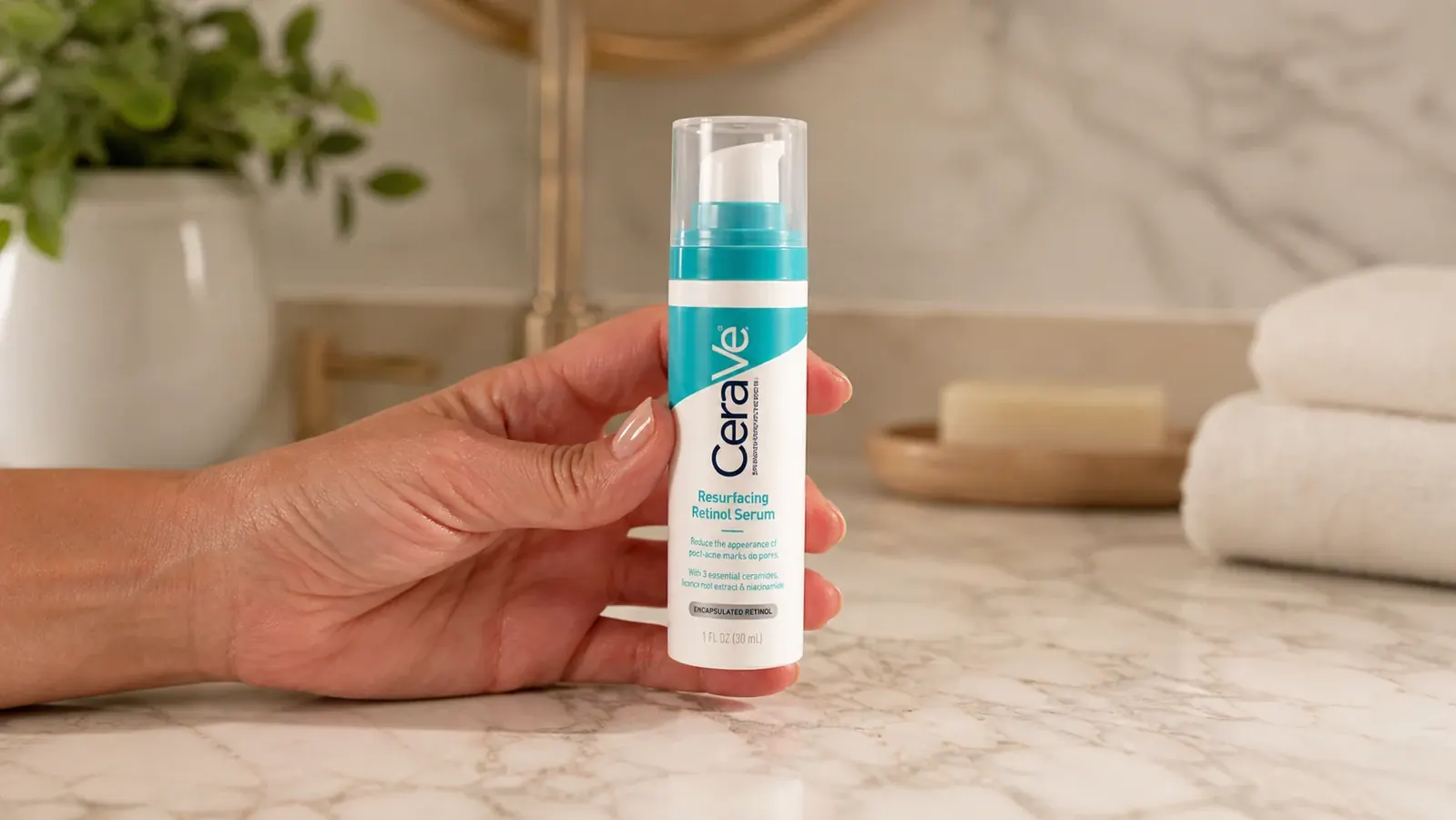
I started looking at what was available and landed on the CeraVe Resurfacing Retinol Serum partly because of the formulation and partly because I was not prepared to spend serious money on an experiment. The serum uses encapsulated retinol, which releases gradually and is considerably less irritating than standard retinol at equivalent concentrations. It also contains niacinamide, which supports the skin barrier and helps with the uneven tone I had noticed gathering around my cheekbones over the past two years. The ceramides keep the texture from leaning dry, which matters when your skin already runs toward dehydration in cooler months. It was around nineteen dollars. I ordered it the afternoon I made the decision, which is not my usual approach. I am normally the person who takes three weeks to commit to a new cleanser.
If post-menopausal skin hesitation is the only thing between you and retinol, this is the formulation to try first.
CeraVe Resurfacing Retinol Serum uses encapsulated retinol with niacinamide and ceramides, designed to resurface without stripping the barrier. It's what I reach for every night now, at week eight and counting.
Amazon Check Today's Price on Amazon →
The first two weeks were unremarkable, which I mean as a compliment. Nothing happened that alarmed me. No flaking, no redness, no stinging. I was using it every third night to begin, over a thin layer of my regular moisturizer as a buffer. Some people apply it directly to clean skin; I am not some people. My skin is 56 years old and has opinions. The buffering worked. By week three I was using it every other night. By week five, most nights.
The changes were not dramatic and they did not arrive in a useful order. The first thing I noticed was that my skin felt different under my fingers in the morning, smoother in a way that was almost structural rather than surface-level. The texture I had come to think of as normal, a slight roughness across my forehead and along my jaw, started to ease. My foundation sat differently, which is one of the practical markers I pay attention to because it is honest. Foundation does not lie. It shows you exactly what the surface underneath is doing.
Around week six, a colleague asked if I had done something to my skin. She did not mean a specific something. She meant that general observation women make when someone looks well rather than worked on. I had not had a facial, had not changed anything else in my routine. It was the serum. I am reasonably certain of that because I am the kind of person who changes one thing at a time and tracks it. Occupational habit from years of testing products.

What I did not see was a dramatic reduction in the lines around my mouth that have been there since my forties. Those are deeper and are not going anywhere on a retinol timeline. I also had a brief dry patch on one cheek around week four, which resolved when I added an extra moisturizing step. No one told me about the brief dry patch in week four. Consider this your warning, and consider it manageable.
What I'd Tell You If We Were Sitting at My Kitchen Table
If you have been avoiding retinol because you are worried your post-menopausal skin cannot tolerate it, I would tell you that your concern is reasonable but probably outdated. The formulations available now are genuinely different from what we were reading about ten years ago. Encapsulated retinol is not a marketing story. It is a real delivery mechanism that changes how the ingredient behaves on the skin. The key is starting slow, one part that no article tells you clearly enough. Not every other night. Every third night. For two weeks. Over moisturizer if your skin runs dry. Then increase from there. Give it six weeks before you decide anything. The changes are not quick, but they are real.
I would also tell you that nineteen dollars is not the barrier it might feel like. I spent considerably more than that over three years on products that were doing very little. The CeraVe serum is not the only option worth considering, but it is where I started and where I am still, at eight weeks in, with no plans to change. It is working. Not in a way that turns back time, which is not a goal I find interesting. In a way that gives my skin what it actually needs at this stage, which is exactly the goal.
Eight weeks in. Still using it. Still the same nineteen-dollar bottle.
CeraVe Resurfacing Retinol Serum. Encapsulated retinol, niacinamide, ceramides. Designed for the skin that needs resurfacing without the irritation of standard retinol. Start every third night. Be patient. It is worth it.
Amazon Check Today's Price on Amazon →