

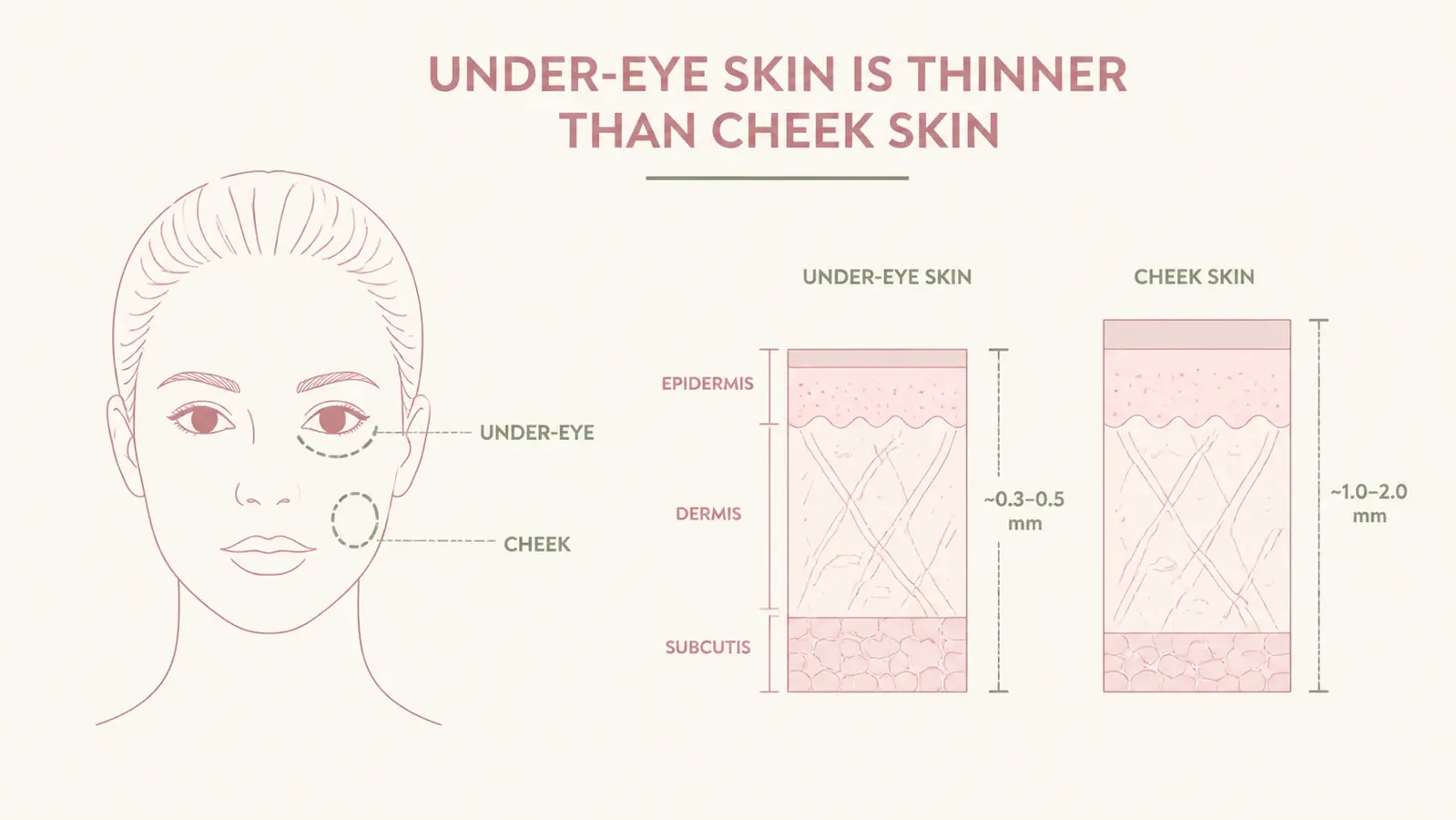
For years I did what most women do: patted my regular face moisturizer under my eyes, figured it was close enough, and moved on. It is not close enough. The skin under your eyes is about 0.5mm thick, roughly a third of the thickness on your cheeks, and after 50 that gap widens as collagen production continues its slow decline. Face moisturizer is formulated for facial skin in general. Under-eye skin is a specific, different situation. It has fewer oil glands, less structural support, and sits over a capillary network that shows through more easily as the skin thins. A product designed for it does different things than one designed for your forehead.
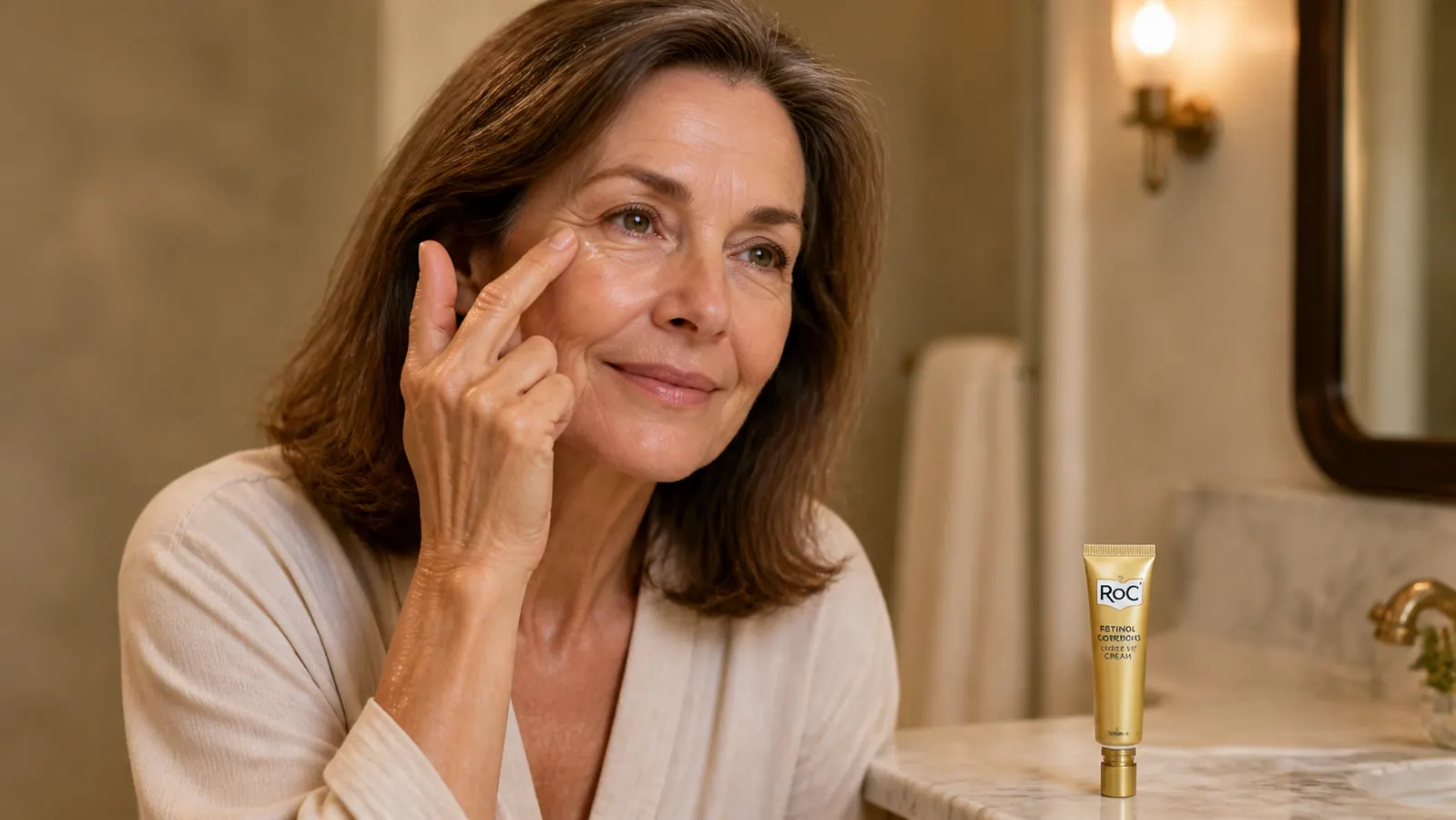
This article is not a pitch for any eye cream in particular. It is a list of ten things I started noticing in my mid-fifties that turned out to be signs my usual skincare routine was not addressing what was happening in that one small zone. If several of these sound familiar, a dedicated retinol eye cream may be the one addition worth making. The RoC Retinol Correxion Under Eye Cream is the product I tested and the one referenced throughout this list, because it is what I actually used. You can read the longer review at the link below.
Your moisturizer is not designed for under-eye skin. This is.
RoC Retinol Correxion Under Eye Cream uses a stabilized retinol plus a mineral complex. It is one of the most reviewed eye creams on Amazon, with over 33,000 ratings. Check current pricing before you work through the list.
Amazon Check Today's Price on Amazon →Your concealer settles into fine lines within an hour
This is the one that tends to break the denial. You apply your concealer, it looks fine, and by mid-morning it has gathered into every small crease under your eye like it has been directed there. Fine lines under the eyes multiply after menopause partly because retinol production in skin cells slows. A retinol eye cream, applied nightly, can stimulate cell turnover in that area over weeks, which gradually smooths the surface those lines sit on. The RoC formula does this without the tight, flaky reaction I got from using a regular retinol serum too close to my eyes.
The skin under your eyes looks crepey, not just dry
Dryness and crepe are different problems. Dryness responds to moisturizer. Crepe, that fine, tissue-like wrinkling you notice when you stretch the skin slightly, reflects a loss of structural protein. It is common under the eyes first because the skin there is thinnest. Retinol is one of the few topical ingredients with consistent evidence for stimulating collagen synthesis. A dedicated eye cream delivers it in a concentration appropriate for that sensitive zone, which is typically lower than you would find in a full-face retinol serum.
You wake up puffy and it does not resolve by nine in the morning
Morning puffiness in your thirties typically fades on its own within twenty minutes. After fifty, it can linger. Lymphatic drainage slows with age and thinner skin provides less structural resistance against fluid accumulation. Eye creams formulated for this area often include ingredients that support circulation and gentle fluid movement. What they cannot do is fix poor sleep or salt intake, so if puffiness is your primary concern, lifestyle factors matter as much as topical treatment. But for the baseline puffiness that persists regardless, a targeted product is more useful than your face moisturizer.
Dark circles have deepened since your late forties
There are several types of dark circles and they do not all respond to the same treatment. Vascular dark circles, the blue-purple type, result from blood vessels showing through thin skin. Pigmentation dark circles are brownish. Structural dark circles come from hollowing, which casts a shadow. After fifty, you often have some combination of all three. Retinol addresses the vascular type indirectly by plumping and thickening the skin above the capillaries over time. It is not a four-week fix, but consistent use over three or four months produces measurable change for many women.
You feel a slight tightness or pulling sensation when you smile
Loss of elasticity shows up as sensation before it becomes fully visible. When the skin under your eyes feels tight at the outer corners when you smile or squint, the elastin network has thinned. Elastin loss is not reversible in the way collagen stimulation is, but retinol can slow the rate of further decline. The key is consistency. Applying an eye cream four nights a week for three months produces better results than ten nights straight followed by forgetting it for a month.
Under-eye skin is about 0.5mm thick, roughly a third of the thickness on your cheeks. It responds to what you put on it differently, and in most cases, more sensitively.
You have tried a retinol serum near your eyes and it stung
This is a sign you need an eye-specific formula rather than a sign you need to avoid retinol near your eyes entirely. Full-strength facial retinol serums are too much for the orbital zone. Eye creams with retinol are formulated at concentrations appropriate for that sensitivity, and often buffered with moisturizing ingredients that reduce irritation. I made the mistake of using my regular CeraVe retinol serum at the orbital bone for two weeks before learning this. Switching to the RoC eye cream eliminated the stinging while keeping the retinol benefit.
Your upper cheeks look moist but the under-eye area still looks papery
Under-eye skin has very few sebaceous glands. It cannot self-moisturize the way the rest of your face can, even slightly. After fifty, this limitation becomes more visible because what little natural lubrication existed has declined further. Your face moisturizer, applied from the cheek area upward, often does not reach the true under-eye zone in adequate amounts or at the right weight. Eye creams are formulated denser, to stay put on a vertical surface and penetrate skin that cannot pull moisture from anywhere else.

You notice a slight hollow where the under-eye meets the cheek
The tear trough. It becomes more prominent as fat pads shift and bone structure changes slightly with age. A topical cream cannot fill structural loss. What it can do is keep the skin over that area plump enough that the transition between hollow and cheek looks less stark. Consistent retinol use, by promoting collagen, adds a small but real amount of skin thickness over time, which softens the visual effect of hollowing without needing filler.
The skin at your outer eye corner has become loose
Crow's feet are expected. Loose skin that moves when you do not intend it to is a different thing. At the outer orbital corner, the skin lacks the bony support that the rest of the orbital rim provides. Gravity and gravity alone has more influence here. Retinol can improve the density of the dermis in this area over a consistent application period, which helps the skin hold its position better. This is one of the areas where the RoC Correxion formula has the most visible effect over ten or more weeks.
You look tired even when you are not
This is the cumulative effect of most of the points above. Fine lines, crepe, mild puffiness, slight hollowing, and a loss of skin brightness in one concentrated area combine to read as fatigue even when you slept eight hours. The under-eye area is where most people assess overall vitality and rest at a glance, because it is where the effects of aging are fastest and most visible. Addressing it with a product designed for it does not erase time. It does mean the story your face tells at rest is a more accurate one.
What I Would Skip
If you are looking at eye creams with peptide complexes priced above sixty dollars, I would start with something more straightforward. Peptide research for topical application is promising but the translation from lab to real skin at realistic concentrations is still inconsistent. Retinol has three decades of human-skin evidence behind it. It is not exciting but it works. Start with the evidence, not the marketing. If RoC works for you over twelve weeks, you will have a clear baseline. You can always add more later from an informed position.
For a deeper look at what the ten weeks of testing actually produced, including the less flattering weeks two and three where nothing seemed to be happening, see the full review. And if puffiness is your main concern, the routine guide covers the lifestyle factors that work alongside topical treatment. Links to both are below.
Related reading: RoC Retinol Correxion Eye Cream: Ten Weeks of Testing on Mature Skin and How to Reduce Eye Puffiness and Dark Circles After 50.
One product. Consistent use. A more accurate version of how rested you actually are.
The RoC Retinol Correxion Under Eye Cream is available on Amazon with over 33,000 reviews and buy-box verified stock. If you have checked several boxes on this list, it is a reasonable place to start.
Amazon Check Today's Price on Amazon →