

Three years ago I would have filed collagen powder under "expensive placebo" and moved on. I spent two decades editing beauty pages, which means I have watched an extraordinary number of ingredients arrive with clinical backing and leave quietly when the results didn't hold up at scale. So when Vital Proteins collagen peptides started appearing on my radar, I was not rushing to open my wallet. What changed my mind was not a testimonial. It was a 2023 randomized controlled trial in the Journal of Cosmetic Dermatology showing statistically significant improvements in skin hydration and elasticity at 12 weeks in women over 45 who took 10 grams of hydrolyzed collagen daily. That is a real study, not a brand-funded brochure. I decided the thing to do was run my own three-month trial and write down exactly what I noticed, including the parts that did not match the marketing copy.
A note on what I was working with before I started: I am 56, two years post-menopause, and I have the skin changes that come with that. My skin is drier than it was at 45. The crepey texture on my chest and inner arms appeared almost overnight around the time I turned 53. My nails had become brittle in a way that felt new. And I have mild stiffness in my right knee that my orthopedist described as early-stage wear, not injury. I am not in crisis. But I noticed the changes, and I was curious whether a consistent, unglamorous daily habit like adding collagen powder to coffee might shift any of it.
The Quick Verdict
Real evidence supports the hydration and elasticity claims at 10-12 weeks. Nail changes are modest. Joint comfort is plausible but harder to isolate. Hair results are the most overstated. Worth trying if your expectations match what the research actually shows.
Amazon Check Today's Price →Wondering if the skin hydration research holds up for you? The only way to know is to run the trial yourself.
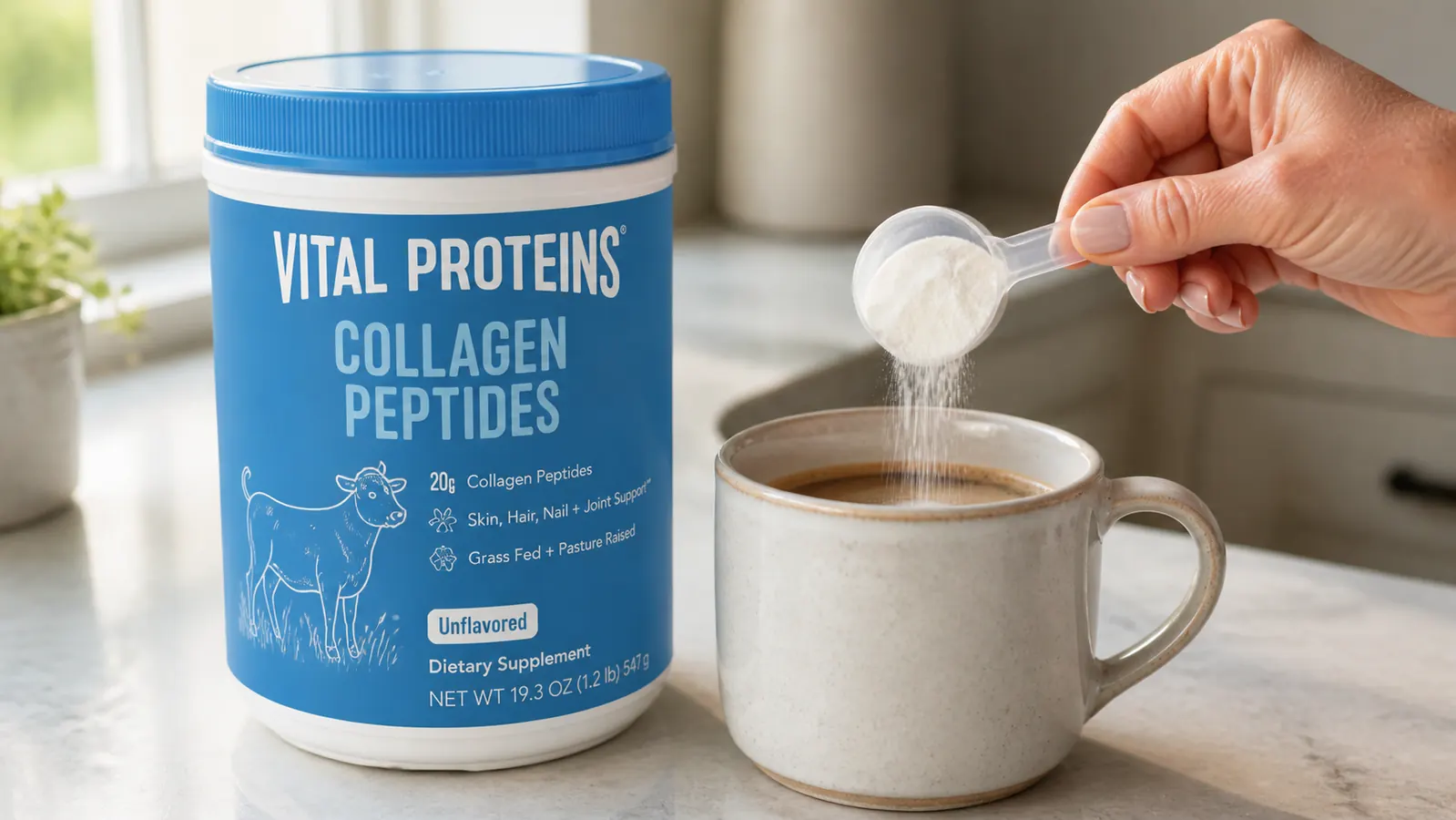
Vital Proteins collagen peptides are unflavored, dissolve cleanly in hot coffee or tea, and the serving size (two scoops, roughly 20g) fits within the dose range studied in clinical trials. Check the current price before you decide.
Amazon Check Today's Price on Amazon →How I Used It for Three Months
My protocol was simple because simple is what I could actually maintain. Every morning, before I did anything else, I added two scoops of Vital Proteins collagen peptides to my coffee. That is roughly 20 grams of collagen protein per serving. I stirred for about 15 seconds. It dissolved completely with no clumping and no detectable flavor change in the coffee, which mattered to me. I was not interested in a supplement that would require me to rethink my morning.
I did not change my skincare routine during this period. I was already using a retinol serum three nights per week and a ceramide moisturizer morning and night. I kept those the same so that any changes I noticed could be more credibly attributed to the collagen rather than a new topical. I also made a point of photographing my hands and the skin at my temples every two weeks, in the same window light, so I had something other than memory to rely on. Memory around gradual change is notoriously unreliable, especially when you want something to work.
I kept a short log, noting things like whether my nails had broken that week, how my knee felt after the stairs in the morning, and any comments from anyone who hadn't seen me recently. I did not tell most people I was taking the supplement, which meant unsolicited observations were more useful than solicited ones.
What Collagen Peptides Actually Are (And What They Are Not)
This is the part of the conversation that tends to get skipped in favor of before-and-after photography. Vital Proteins collagen peptides are hydrolyzed Type I and Type III bovine collagen, meaning the collagen protein has been broken down into smaller amino acid chains that are more easily absorbed. The product in ASIN B00K6JUG4K also includes hyaluronic acid and vitamin C, both of which appear alongside collagen in several of the more credible clinical studies.
Here is what the evidence supports: when you consume hydrolyzed collagen, the peptides are absorbed into the bloodstream and some research suggests they accumulate in skin tissue and may stimulate fibroblasts, the cells responsible for producing collagen and elastin. The key word is "may." The mechanism is plausible but not fully proven in human tissue. What the studies do show consistently is improvement in skin hydration and some elasticity measures at 8 to 12 weeks. That is the honest scope of the claim.
What collagen peptides cannot do is act topically. When you swallow a powder, it does not travel directly to the dermis of your cheek. The body breaks it down, uses the amino acids, and distributes them according to its own priorities. You are not "feeding collagen to your face." You are providing the building blocks and hoping the body uses them in the places you care about. That distinction matters when you are setting expectations.
You are providing the building blocks and hoping the body uses them in the places you care about. That is an honest description of what a collagen supplement does. It is not a face cream in a canister.
Skin: What I Noticed and When
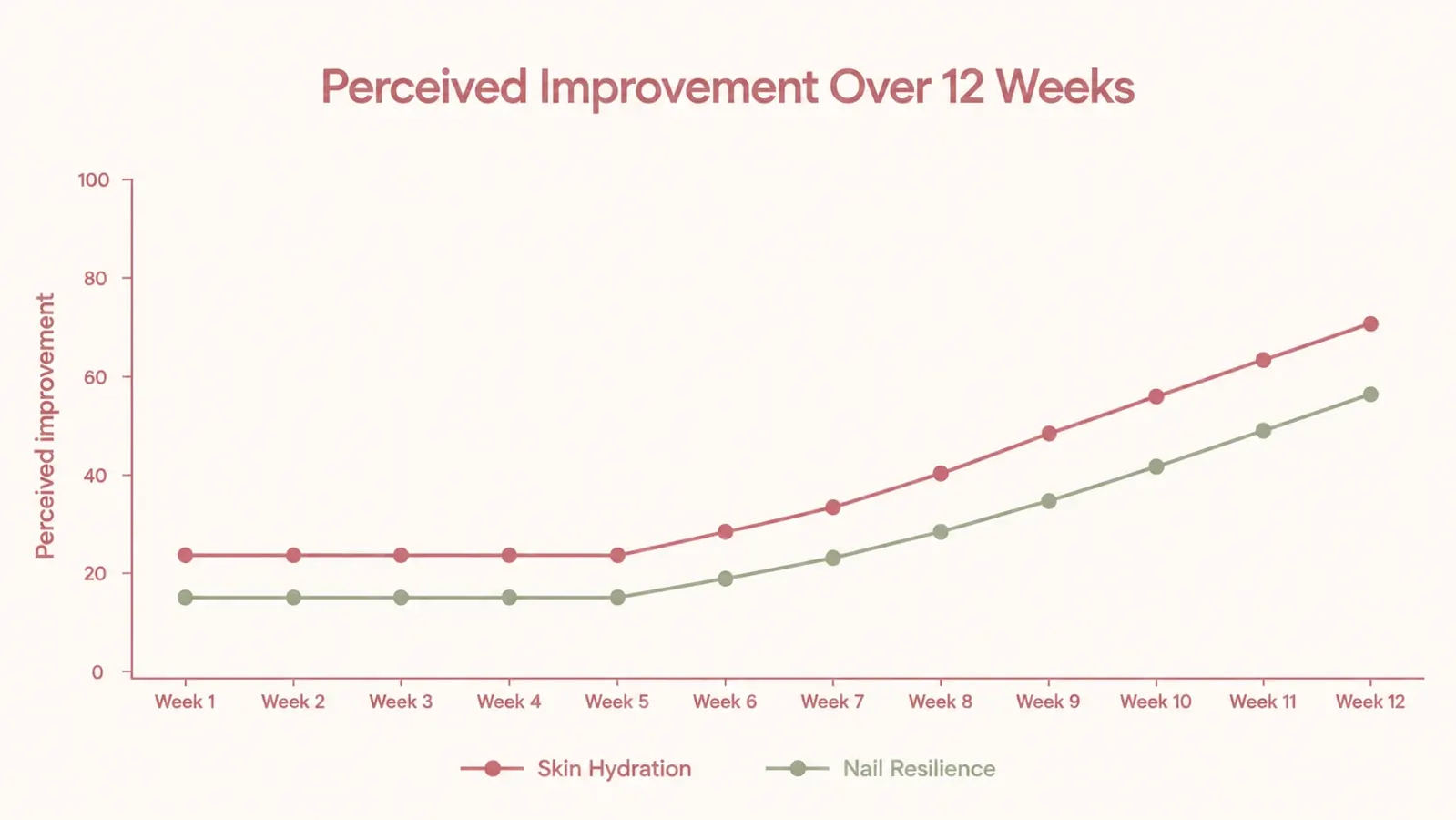
Weeks one through four: nothing I could reliably attribute to the collagen. My skin felt about the same. The photographs showed nothing different. I expected this, because the studies that show results generally show them starting at eight weeks, not two.
By week seven I noticed that my skin felt more comfortable through the day. Not dramatically tighter or "younger," but less tight after washing, less prone to that sensation of dryness by mid-afternoon. I attributed this partly to improved hydration, which is the most consistently supported benefit in the literature. By week ten, the photographs at my temples showed a subtle difference in how the skin sat, though I am cautious about overclaiming here because lighting variation and hydration levels on any given morning can shift the appearance considerably.
The crepey texture on my chest, which is where I most hoped to see change, was less improved than I would have liked. I saw modest softening in the texture but nothing approaching resolution. I think this is honest: crepey skin has multiple causes including loss of elastin, fat redistribution under the skin, and sun damage accumulated over decades. A collagen supplement addresses one piece of a complicated picture.
Nails, Hair, and Joints: The More Complicated Story
Nails: I had four nail breaks in the first six weeks, which is about average for me. In weeks seven through twelve I had two. My nails also seemed to grow slightly faster, though I did not measure this precisely. I consider this a mild positive result. Brittle nails in post-menopausal women often have multiple causes, including hormonal changes affecting keratin production, so I am not going to attribute the full improvement to collagen alone.
Hair: This is where I think the marketing around collagen supplements is least honest. I did not notice any meaningful change in my hair density, texture, or growth rate over three months. My hair is fine and has thinned somewhat since menopause. Three months of collagen peptides did not change that in any way I could observe. I want to name this clearly because the category tends to make extravagant hair claims and I think those claims send women on an expensive chase that ends in disappointment.
Joints: My right knee is where I noticed the most subjectively meaningful change, and it is also where I am most cautious about attribution. By week eight, the morning stiffness on the stairs was slightly less pronounced. I noticed it less often. But I also started walking thirty minutes most mornings during the same period, which is a confounding variable I cannot dismiss. Type II collagen, not Type I and III, is the form most specifically studied for joint cartilage. Vital Proteins contains Type I and III. The joint benefit, if there is one, may be more general, related to the amino acid glycine and its role in connective tissue maintenance.
The Product Itself: Dissolution, Taste, and Consistency
Vital Proteins dissolves cleanly in hot liquid, which is its most practically important feature. I stirred it into coffee without a blender and had no clumping, no gritty residue, and no flavor change that I could detect. I tried it once in cold water and it did not dissolve as well. For cold liquids you need a shaker or a blender. The canister at the 10-ounce size I reviewed lasts approximately 14 days at two scoops per day, which means you go through it faster than the packaging might suggest.
The powder is white and fine. The scoop included is the right size for two servings. The canister is resealable and I had no issues with clumping in the container even through a humid stretch in March. At the current price, this is not an inexpensive supplement, which is part of why honest results matter more here than they do with something that costs seven dollars.
What I Liked
- Dissolves completely in hot coffee or tea with no detectable taste or texture change
- Skin hydration improvement is noticeable and consistent with what the clinical research shows at 8-12 weeks
- Mild nail improvement: fewer breaks in weeks 7-12 compared to weeks 1-6
- Formula includes hyaluronic acid and vitamin C, which are co-factors in collagen synthesis and appear in the better-designed studies
- 213,000+ reviews give a meaningful signal that the product is consistent batch to batch
- Unflavored version works in savory recipes and smoothies as well as hot drinks
Where It Falls Short
- Hair density and thickness: I saw no meaningful change over three months, and the category overpromises here
- Crepey skin texture on chest and arms showed only modest improvement, not the resolution some reviews suggest
- Joint benefit is plausible but hard to isolate from other lifestyle variables; Type II collagen is more specifically studied for joint cartilage
- Price per serving is higher than comparable hydrolyzed collagen powders with similar amino acid profiles
- At two scoops per day, a 10-ounce canister lasts only 14 days, which is easy to underestimate when buying
- Results require patience: expecting anything before week 6 is setting yourself up for early abandonment

Who This Is For
This supplement is worth trying if you are a post-menopausal woman who has noticed changes in skin hydration and nail resilience, and who is willing to commit to a consistent daily habit for at least twelve weeks before drawing conclusions. The research on skin hydration and elasticity at that duration is real, peer-reviewed, and consistent enough that I consider it credible. If you already have a strong skincare routine and you want to add something that works from the inside, collagen peptides have more evidence behind them than most supplements marketed to women in midlife. You also need to be comfortable with the ambiguity: this is a supplement, not a drug, and individual responses vary considerably.
Who Should Skip It
If you are hoping collagen powder will reverse hair loss, fill in deep wrinkles, or eliminate joint pain, I would save your money. Those outcomes are not well-supported by the evidence, and the enthusiastic testimonials online reflect survivorship bias: people who see no result stop taking the supplement and stop reviewing it. If your main concern is hair thinning after menopause, the more evidence-supported route involves ruling out thyroid and iron issues with your doctor, and potentially discussing low-dose biotin or minoxidil with a dermatologist. Collagen peptides are not the intervention for that problem.
If budget is tight, I would also pause. There are less expensive hydrolyzed collagen powders with similar amino acid profiles. The Vital Proteins premium is partly brand equity and partly the addition of hyaluronic acid and vitamin C, both of which are useful but available elsewhere for less. I cover the comparison in detail in my review of Vital Proteins versus Sports Research Collagen, which is worth reading before you buy. And if you want guidance on how to actually build this into a daily routine that you will stick with, I wrote a practical step-by-step guide to adding collagen peptides to your morning.
Three months of daily use gave me real data. The skin hydration result is the one I'd repeat.
If you are ready to run your own trial, Vital Proteins collagen peptides are available on Amazon. Check the current price and size options before buying. The 10oz canister goes faster than you expect at a full 20g daily dose.
Amazon Check Today's Price on Amazon →