
Two hundred thousand reviews is a number that should give you pause before it gives you confidence. I am Margaret Ellis, 56, and I spent a career in magazine beauty editing reading exactly this kind of social proof. Here is what I learned: the review pool for any supplement is self-selecting in a particular direction. People who open the canister, stir a scoop into their morning coffee for a few weeks, notice nothing, and quietly reshelve it do not come back to write a review. People who believe they are feeling better do. The result is a ratings curve that has almost nothing to do with population-level outcomes and almost everything to do with who felt motivated to type four sentences into a review box.
I am not telling you Vital Proteins Collagen Peptides is a bad product. I took it daily for three months. I also read through a representative sample of the clinical research it rests on. Those are two different exercises, and they produce two different sets of conclusions. If you have already read my longer piece on the three-month experience, this article is the one you probably needed first.
The Quick Verdict
A clean, well-sourced collagen powder with real but modest benefits for skin hydration. Not a joint supplement, not a miracle, and supported by research that is far less definitive than the marketing implies. Worth trying if you approach it with accurate expectations.
Amazon Check Today's Price →If you have read enough glowing testimonials and want to try it with accurate expectations, here is where to check the current price.
Vital Proteins Collagen Peptides dissolves cleanly in hot or cold liquid, has no detectable taste in coffee, and comes from grass-fed bovine hides. Those things are true. So is everything else in this review.
Amazon Check Today's Price on Amazon →The Survivorship Problem in Supplement Reviews
Let me be specific about the review math. At the time I am writing this, Vital Proteins Collagen Peptides carries roughly 213,000 ratings on Amazon and a 4.5-star average. That sounds like strong evidence. It is not nothing, but it is not what it appears to be, either. Behavioral economists call it survivorship bias: the outcome you see reflects only the people who stayed, not the full population that started. In supplement categories, people who see no result typically exit without comment. The floor of the sample is missing.
This is not unique to Vital Proteins. It applies to nearly every supplement on Amazon. But it matters more for collagen than for, say, a vitamin C tablet, because collagen's effects are slow, subtle, and not universally present. A meaningful proportion of users will be in the group that notices nothing in eight weeks and moves on. Those people are not in the 213,000.
What this means practically: when you read a review that says 'my nails are stronger and my skin looks plumper,' that person may genuinely be right about their own experience. What you cannot know is how many people had the same experience versus how many noticed nothing and simply left. The honest answer is that nobody tracks this.
This Is a Skin and Nail Supplement. It Is Not a Joint Supplement.
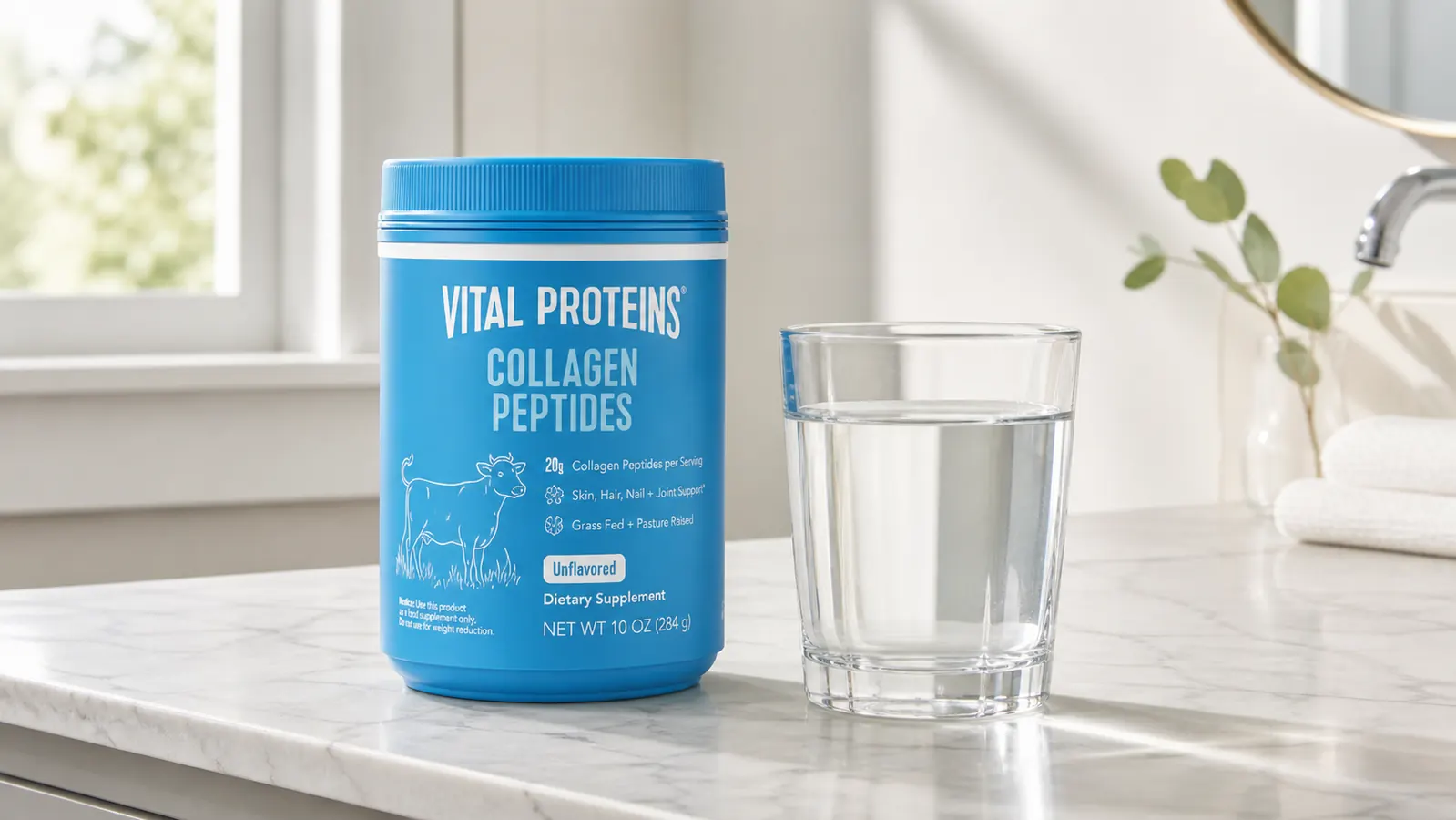
Vital Proteins Collagen Peptides contains Type I and Type III collagen. The label says so, in small print, but the marketing leans heavily on words like 'joint health,' 'bone,' and 'mobility.' This is where the sourcing matters. Type I and III collagen are structural proteins found in skin, hair, nails, tendons, and the gut lining. They are not the primary collagen type in cartilage.
Joint cartilage is primarily Type II collagen. If joint comfort is your primary reason for buying a collagen supplement, you are looking at the wrong product. Type II collagen comes from chicken sternum cartilage, not bovine hide, and requires a completely different extraction process. Products designed specifically for joint support, such as UC-II, use undenatured Type II collagen in doses of 40mg, not 10 grams. The mechanism is different. The research is different. The products are not interchangeable.
Vital Proteins is transparent about being a bovine, Type I and III product if you read carefully. The broader marketing around 'joint health' is technically defensible, because tendons and ligaments do contain some Type I collagen. But if you are a woman in her mid-fifties with knee discomfort from years of running or early arthritis, this canister is not what the research would point you toward. Know what you are buying before you decide what to expect.
The review pool for any supplement reflects only the people who stayed. The ones who noticed nothing left without comment. That floor of the sample is what makes 213,000 four-star ratings look like evidence when it is really a selection.
The Research Is Thinner Than the Marketing Suggests
Vital Proteins does reference clinical research. There are legitimate studies on hydrolyzed collagen peptides and skin hydration, and some of them show statistically significant improvements, particularly in women over 40. This is real. I am not dismissing it. But there are several things worth knowing about that body of literature before you treat it as settled science.
First, the majority of published collagen peptide studies are either funded by collagen manufacturers or conducted by researchers with industry ties. This does not automatically invalidate the findings, but it is a pattern that warrants some skepticism. Independent, large-scale replication is sparse. The same small handful of studies tend to get cited by the same group of supplement brands.
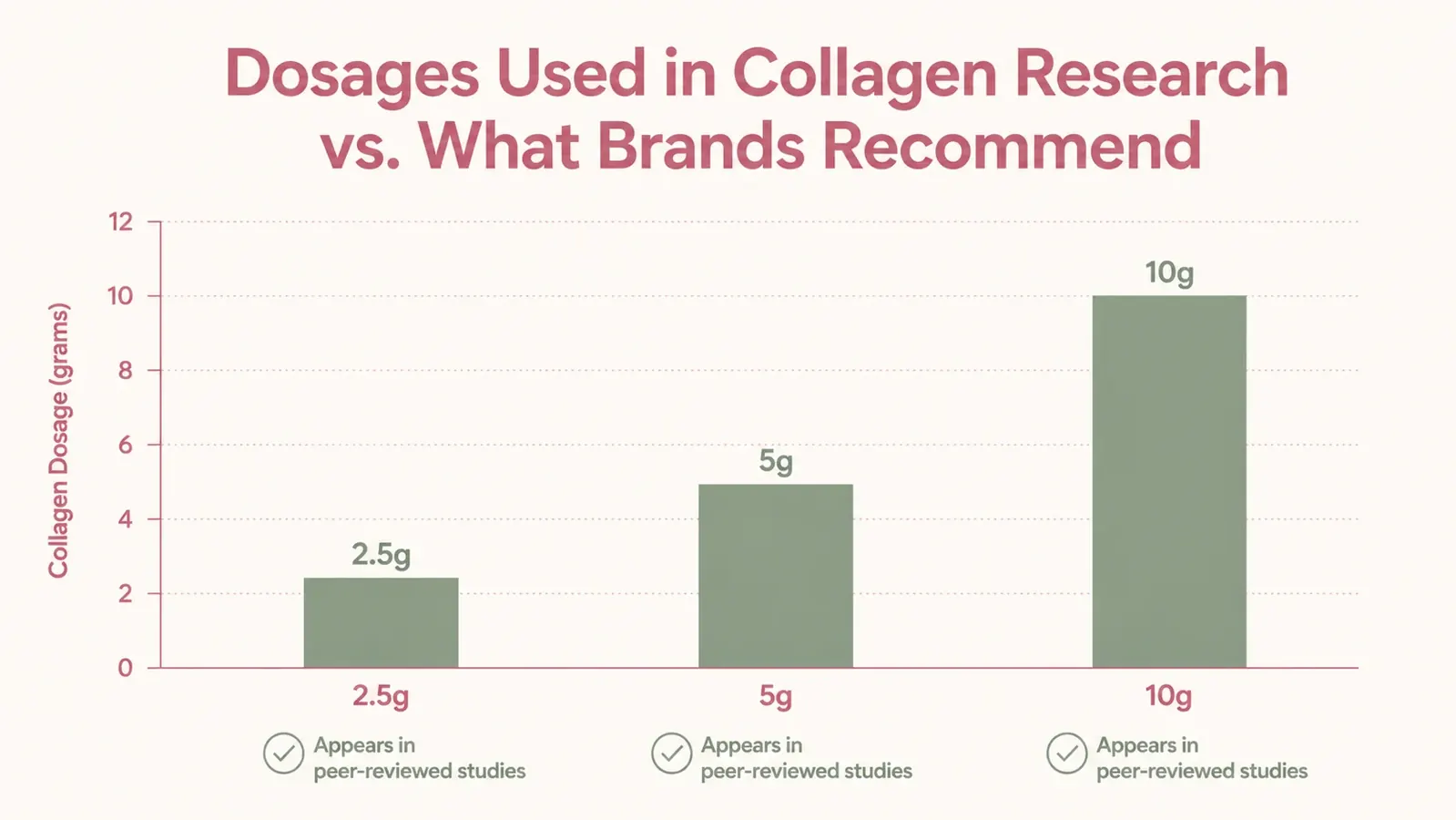
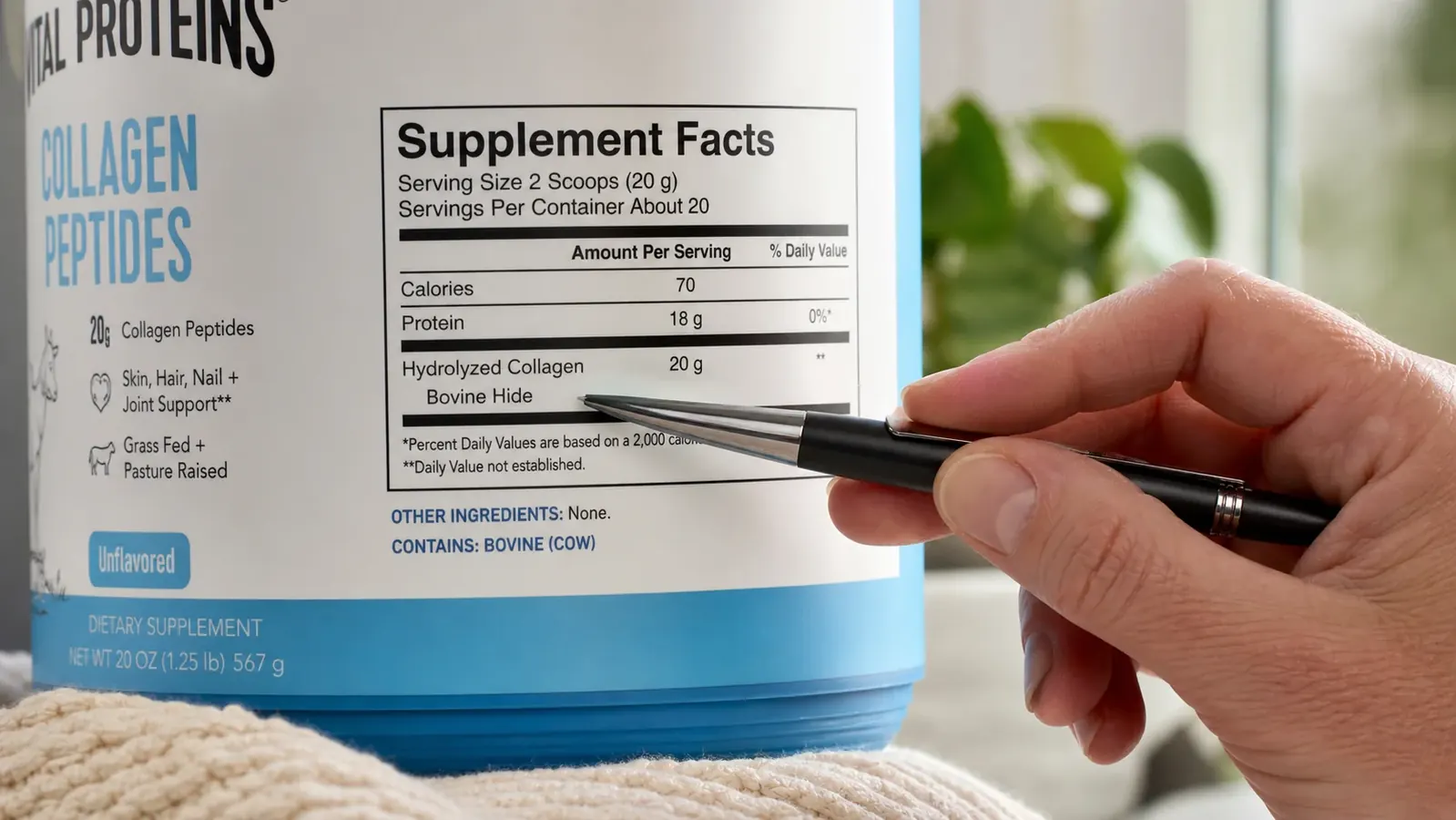
Second, the positive studies on skin hydration typically used doses between 2.5 grams and 5 grams per day. Vital Proteins recommends two scoops, which is approximately 20 grams. The canister in the 10oz size delivers roughly 10 grams per scoop. The research basis for the dose most people are taking is not clearly established. More is not the same as better when the mechanism relies on specific peptide absorption, and some researchers have suggested that higher doses may not increase absorption proportionally.
Third, the placebo effect in supplement trials is substantial and often undercontrolled. Studies where participants know they are taking a beauty supplement tend to show larger self-reported improvements than double-blind trials. Several collagen studies relied on self-assessment of skin appearance rather than dermatological measurement. That is a meaningful methodological limitation.
What the Bovine Sourcing Actually Means
Vital Proteins uses grass-fed, pasture-raised bovine collagen. This is a genuine quality marker. The sourcing affects the amino acid profile and, in theory, reduces exposure to certain contaminants associated with conventionally raised cattle. The 'grass-fed' label is also a meaningful differentiator from cheaper collagen powders that source from industrial feedlot hides, where the collagen quality is more variable.
What it does not change is the fundamental nature of the ingredient. Bovine collagen is extracted from hides, the outer skin of cattle, not from muscle tissue. This is not a problem, it is simply the reality of what you are consuming. The protein is hydrolyzed, meaning it has been broken down by enzymes into smaller peptides that the body can absorb more readily than intact collagen could be. This processing step is what makes supplementation theoretically useful at all.
Some women with sensitivities to beef or with ethical commitments around bovine products should know this clearly. There are marine collagen alternatives sourced from fish skin, which contain primarily Type I collagen and are often better tolerated by those with bovine sensitivities. The absorption profile may differ somewhat, though the evidence on which source is superior for humans is not settled.

Gut Sensitivity Is a Real Issue for Some Women
Collagen peptide powder is almost entirely protein, and high protein loads can trigger digestive symptoms in some people, particularly at the doses collagen brands recommend. In my own experience, the full two-scoop dose caused mild bloating in the first two weeks. Reducing to one scoop resolved it. This is not unusual.
Women in perimenopause and postmenopause often experience increased gut sensitivity due to the connection between estrogen levels and intestinal motility. If you already deal with bloating, IBS symptoms, or a sensitive digestive system, start with a half scoop and build up. Do not assume the recommended serving size is calibrated for your body. It is calibrated for the majority of a review pool that skews toward people who tolerate it fine.
Some users also report a mild sulfuric aftertaste at higher doses, linked to the amino acid content. In hot coffee with a strong roast this is undetectable. In cold water or a lightly flavored smoothie it can be noticeable. The unflavored version is genuinely close to neutral, but not perfectly so at full dose.
What I Actually Noticed After Three Months
I am 56, with dry skin that became noticeably drier after menopause. My nails have been prone to peeling for years. I added one scoop of Vital Proteins to my morning coffee daily, which gave me approximately 10 grams per day, and I kept everything else in my routine constant so I would have a clean read.
At six weeks I noticed my nails were peeling less and had grown faster than usual. This is the most concrete change I observed, and I attribute it with some confidence to the collagen, because it is the one thing that changed and nails are among the most documented benefits of collagen supplementation. Whether this matters to you depends on how much nail quality features in your concerns.
Skin hydration is harder to assess honestly. My skin did feel marginally more comfortable through the day, particularly on my arms and neck where post-menopausal dryness has been most pronounced. I cannot tell you with certainty how much of that is collagen, how much is the placebo effect from doing something deliberate for my skin every morning, and how much is the fact that I was also drinking more water because I was thinking about my routine. These variables are nearly impossible to separate in a self-experiment.
What I did not notice: any visible reduction in facial lines, any change in skin firmness that I could distinguish from normal variation, or any improvement in energy or joint comfort. Those benefits appear frequently in the reviews. They were not part of my experience.
What I Liked
- Clean formulation with minimal additives and no artificial sweeteners
- Sourced from grass-fed bovine hides, which is a genuine quality indicator
- Dissolves completely in hot and cold liquids with no detectable lumps
- Virtually tasteless in coffee or smoothies at one-scoop doses
- Nail growth and strength changes are among the more consistently documented effects
- The hyaluronic acid and vitamin C inclusion in this version may support skin hydration through complementary pathways
Where It Falls Short
- Type I and III bovine collagen is not the right type for joint cartilage support
- Most supporting research used 2.5 to 5 gram doses, not the 10 to 20 gram doses typically recommended
- A large portion of the clinical research is industry-funded, with limited independent replication
- Can cause bloating in women with gut sensitivity, particularly at full dose
- Skin improvement results are genuinely modest and not universal
- The survivorship bias in the review pool makes the 4.5-star average misleading as a guide to likely outcomes
Who This Is For
Vital Proteins Collagen Peptides is a reasonable addition to a routine for a woman over 50 who wants to support skin hydration and nail integrity, understands that the effects will be modest rather than dramatic, and is approaching this as one component of a broader skin and nutrition strategy rather than as a primary intervention. If you drink coffee every morning already, the habit friction is essentially zero. The cost per day is manageable. The downside risk is low.
It is also a reasonable choice for someone who has already tried topical approaches to dryness and wants to explore whether an internal approach adds anything on top. There is plausible biological logic to the idea that collagen peptides may support the skin's structural protein production, even if the research proving it is less conclusive than the brands would have you believe.
Who Should Skip It
Skip it if your primary goal is joint support, especially cartilage-related joint comfort. You need a different product and a different collagen type. Skip it if you are expecting visible facial rejuvenation on any timeline. The research simply does not support that outcome at any dose. Skip it if you have significant digestive sensitivity and are not prepared to experiment with lower doses. And skip it if you are making this purchase primarily because the number 213,000 reviews felt like overwhelming consensus. That number does not mean what it appears to mean.
There is also an honest cost question. This is not a cheap supplement at current pricing for what the evidence supports. If budget is a consideration, there are less expensive hydrolyzed collagen powders with similar amino acid profiles and similar sourcing credentials. The Vital Proteins branding and marketing budget is reflected in the price. What you are paying for beyond the collagen itself is worth knowing.
It is a decent product for what it is. Know what it is before you buy.
If nail integrity and modest skin hydration support with a clean, tasteless powder that goes in your morning coffee sounds like a reasonable addition to your routine, the current price is worth checking. Go in with accurate expectations and you will not feel misled.
Amazon Check Today's Price on Amazon →