

A short note before we begin: this piece walks through my experience with Centrum Silver Women, the multivitamin I have been using personally. Now to the story. The last time I stood in a supplement aisle trying to choose a multivitamin, I counted fourteen options aimed at women in my general age bracket. Most of them led with the same words on the front panel: "complete," "comprehensive," "designed for women over 50." Not one of those labels told me what I actually needed to know. The useful information was on the back, in the dense twelve-point type that most people walk right past. After years of reporting on beauty and wellness, and a blood panel at 53 that showed my vitamin D sitting quietly in the insufficient range, I learned to read that back panel like a contract. This guide is what I wish someone had handed me in that aisle.
What changed after menopause is not that you suddenly need more of everything. It is more specific than that. Your iron needs dropped significantly once your menstrual cycle ended. Your ability to absorb B12 from food becomes less reliable as stomach acid production slows with age. Your skin synthesizes vitamin D less efficiently than it did at thirty-five, and D2, the plant-based form used in many cheaper multivitamins, converts to active D3 in your body at a fraction of the rate. These are real, documented shifts, and a multivitamin formulated for the general adult population, or even for women broadly, may not account for them. Here is how to check.
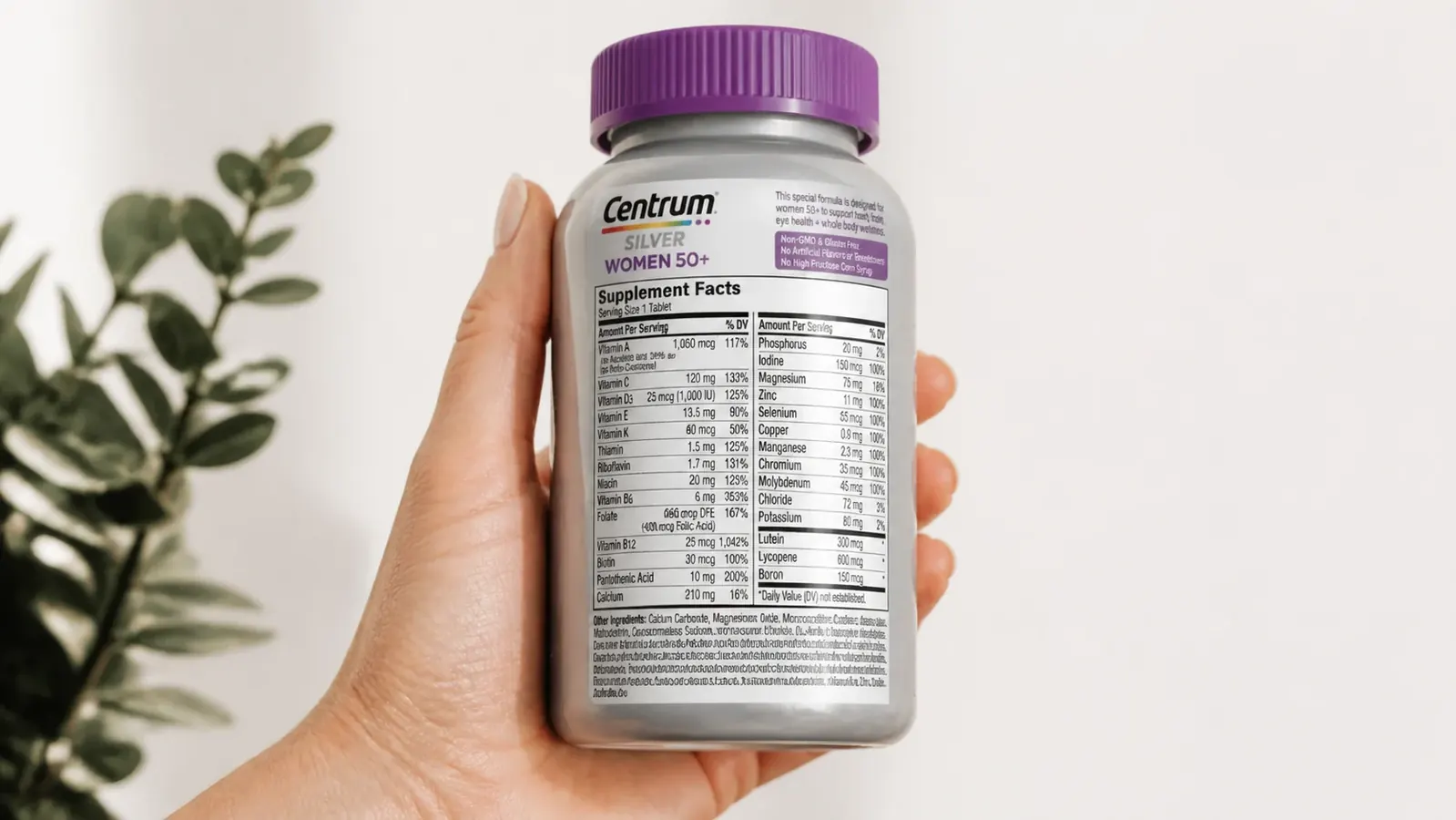
If You Want to Skip the Research: Centrum Silver Women 50+ Is What I Use
It has D3, not D2. Iron is near zero, as it should be post-menopause. B12 is at a meaningful dose. It is third-party tested, non-GMO verified, and costs pennies a day. That said, read the steps below before buying anything, including this, so you understand what you are looking at.
Amazon Check Today's Price on Amazon →Step 1: Flip to the Back Panel First. Always.
The front of a multivitamin bottle is marketing. The back is information. Everything on the front, "complete," "silver," "for women," "with antioxidants," is language chosen to attract your attention, not to inform your decision. The supplement facts panel on the back is where the actual formulation lives: what is in it, how much, and in what form. Get in the habit of turning the bottle around before you read anything else. If you are buying online, look for the back-of-label image in the product photos. If a brand does not show the supplement facts in their Amazon listing, that is itself informative.
When you are reading the panel, you are looking for a handful of specific things. The total vitamin count does not tell you much. A multivitamin that lists forty nutrients is not automatically better than one that lists twenty. What matters is whether the key nutrients you need post-menopause are present, at useful doses, in the right forms. The next four steps cover the ones that matter most.
Step 2: Check the Vitamin D Form and Dose
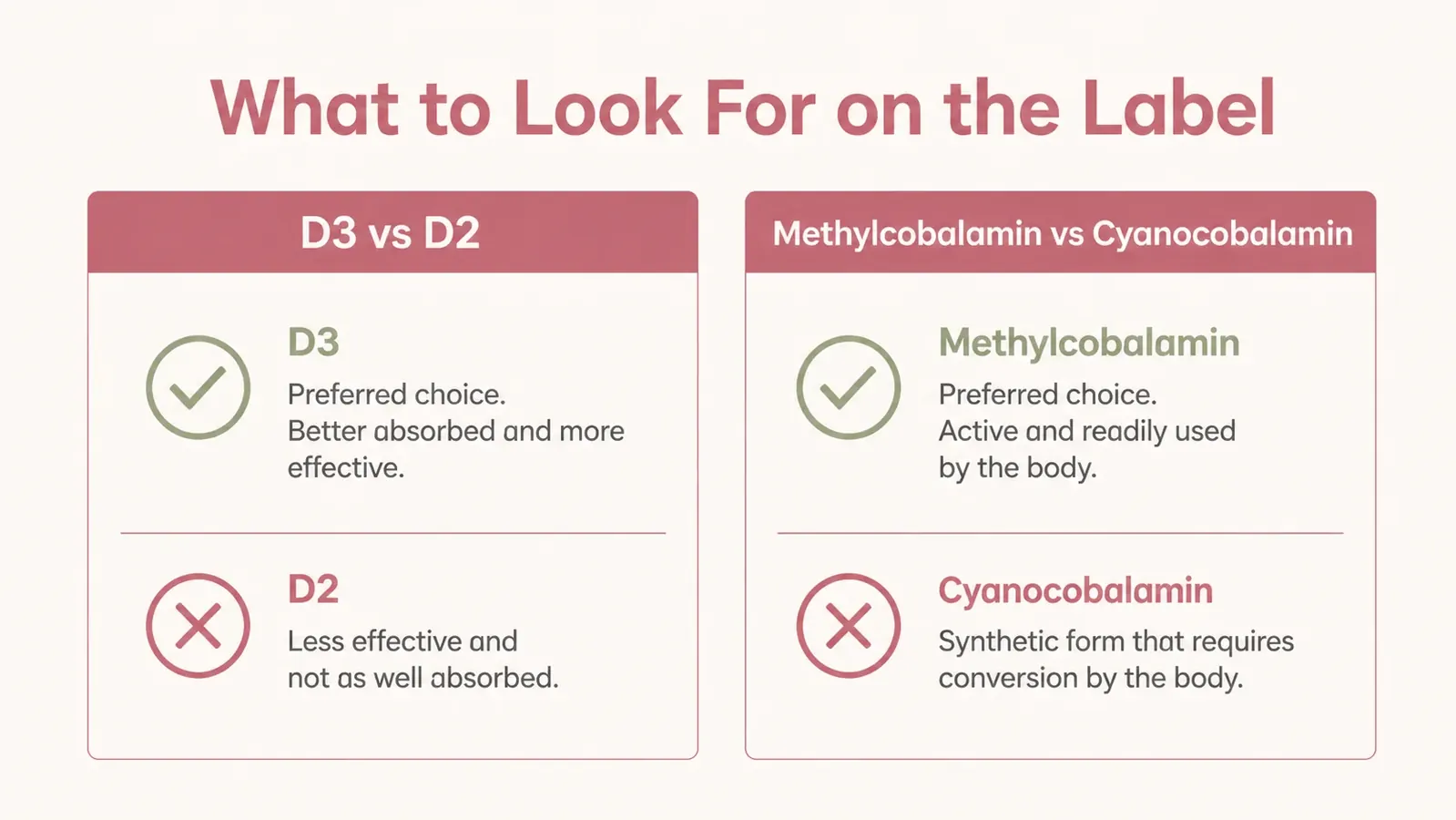
Look for the word cholecalciferol in the ingredient list. That is D3. If you see ergocalciferol, that is D2. The distinction matters because D3 raises blood levels of the active form of vitamin D significantly more efficiently than D2 does. A 2012 meta-analysis in the American Journal of Clinical Nutrition found that D3 is roughly 87 percent more potent at raising and maintaining adequate levels than D2. For a post-menopausal woman, whose skin already synthesizes vitamin D less efficiently than it once did, choosing a formula with D3 is a straightforward way to get more from the same dose.
As for the dose: most women's 50-plus multivitamins deliver 800 to 1000 IU of D3. That range is appropriate as a baseline, though many physicians now recommend that their post-menopausal patients aim for 1500 to 2000 IU total from all sources, including diet and sun exposure. If your doctor has ordered a vitamin D panel and your levels are low, a multivitamin alone probably will not correct that. You may need a separate D3 supplement on top. But for maintenance, 800 to 1000 IU of D3 in your multivitamin is a reasonable foundation.
Step 3: Look at the B12 Dose and, If Possible, the Form
B12 absorption changes as we age because it depends on a protein called intrinsic factor produced in the stomach, and stomach acid production declines with age. The National Institutes of Health estimates that somewhere between 10 and 30 percent of adults over 50 have some degree of reduced B12 absorption from food. One way multivitamins partially compensate is by including B12 in its free crystalline form, which absorbs passively in the gut and does not require intrinsic factor to the same degree. This is why a higher B12 dose in a supplement matters more as you age. Look for at least 100 percent of the daily value, which is 2.4 mcg, and ideally considerably more. Many formulas for women over 50 include 25 mcg or higher.
The form to prefer is methylcobalamin rather than cyanocobalamin. Methylcobalamin is a naturally occurring form that the body can use directly. Cyanocobalamin is synthetic and must be converted by the liver before use. For most people the difference is modest. But if you have any MTHFR gene variants, a common genetic polymorphism that affects methylation, cyanocobalamin is meaningfully less useful. Methylcobalamin is the better choice if you can find it at a similar price. Centrum Silver Women uses cyanocobalamin, which is the standard in this price range. It works for most women. If you have documented methylation issues, it is worth upgrading to a formula using the methyl form.
The front of a multivitamin bottle is marketing. The supplement facts panel on the back is information. Turn it over before you read anything else.
Step 4: Iron Should Be Near Zero
This is the clearest way to tell whether a multivitamin was genuinely formulated for post-menopausal women or simply re-labeled from a general women's formula. Pre-menopausal women need 18 mg of iron daily to account for menstrual blood loss. Post-menopausal women need only 8 mg, roughly the same as men, and that amount is usually obtainable from food alone without supplementation. Excess iron in post-menopausal women is associated with oxidative stress and may interfere with zinc and copper absorption. A well-designed 50-plus formula will contain zero iron or a trace amount at most. If your multivitamin contains 10 mg or more of iron and claims to be designed for women over 50, read the label again more carefully. It may be a general adult women's formula in different packaging.
Centrum Silver Women 50+ contains 0 mg of iron. That is the right call for the target user. If you are post-menopausal and your doctor has identified iron-deficiency anemia, a separate iron supplement under medical supervision is the appropriate route, not a high-iron multi.

Step 5: Check Calcium Dose and Whether You Are Already Getting It Elsewhere
This one requires a bit of arithmetic. Post-menopausal women are commonly advised to get 1200 mg of calcium per day, and many women assume a multivitamin should be covering that. It should not, and here is why. Calcium absorption is dose-limited. Your body can only absorb about 500 mg at a time effectively. Large supplemental calcium doses, particularly from carbonate form, have been associated in some studies with increased cardiovascular risk when intake significantly exceeds dietary need. The current thinking among most dietitians is that you should get the majority of your calcium from food, where it comes packaged with other minerals, and use supplementation to fill genuine gaps.
A good 50-plus multivitamin contains a modest calcium contribution, typically 200 to 300 mg, which acts as a top-up rather than a primary source. If you are already taking a separate calcium supplement, check the combined dose before you add a multi. Doubling up can push you above the tolerable upper intake level of 2500 mg. Centrum Silver Women 50+ contains 200 mg of calcium, which is appropriately restrained. If you drink two to three servings of dairy or fortified plant milk daily, you are likely already at a good base.
Step 6: Look for K2 and Consider Third-Party Verification
Vitamin K2, specifically the MK-7 form, is the nutrient most multivitamins still shortchange in their 50-plus formulas. K2 works in concert with D3 to direct calcium into bone rather than arterial tissue. If you are supplementing D3 consistently and have calcium in your diet or supplements, K2 becomes relevant because it influences where that calcium ends up. Many standard multivitamins include K1 but not K2. They are not the same thing. K1 is primarily involved in blood clotting. K2 is the bone and cardiovascular form. If K2 appears in the ingredient list as menaquinone-7, that is a good sign. If it is absent, and you are concerned about bone density, K2 is worth considering as a standalone supplement.
On third-party verification: the supplement industry in the United States is not as tightly regulated as pharmaceuticals. A brand can claim a dose on the label without guaranteed accuracy. Independent testing by organizations such as USP (United States Pharmacopeia) or NSF International verifies that what is on the label is actually in the bottle. Look for their seals. Centrum Silver is USP-verified, which is one of the substantive reasons it remains a reasonable default option in an industry where label accuracy varies considerably.
Step 7: Gummies Are Not the Same Thing as Tablets. Know the Tradeoffs.
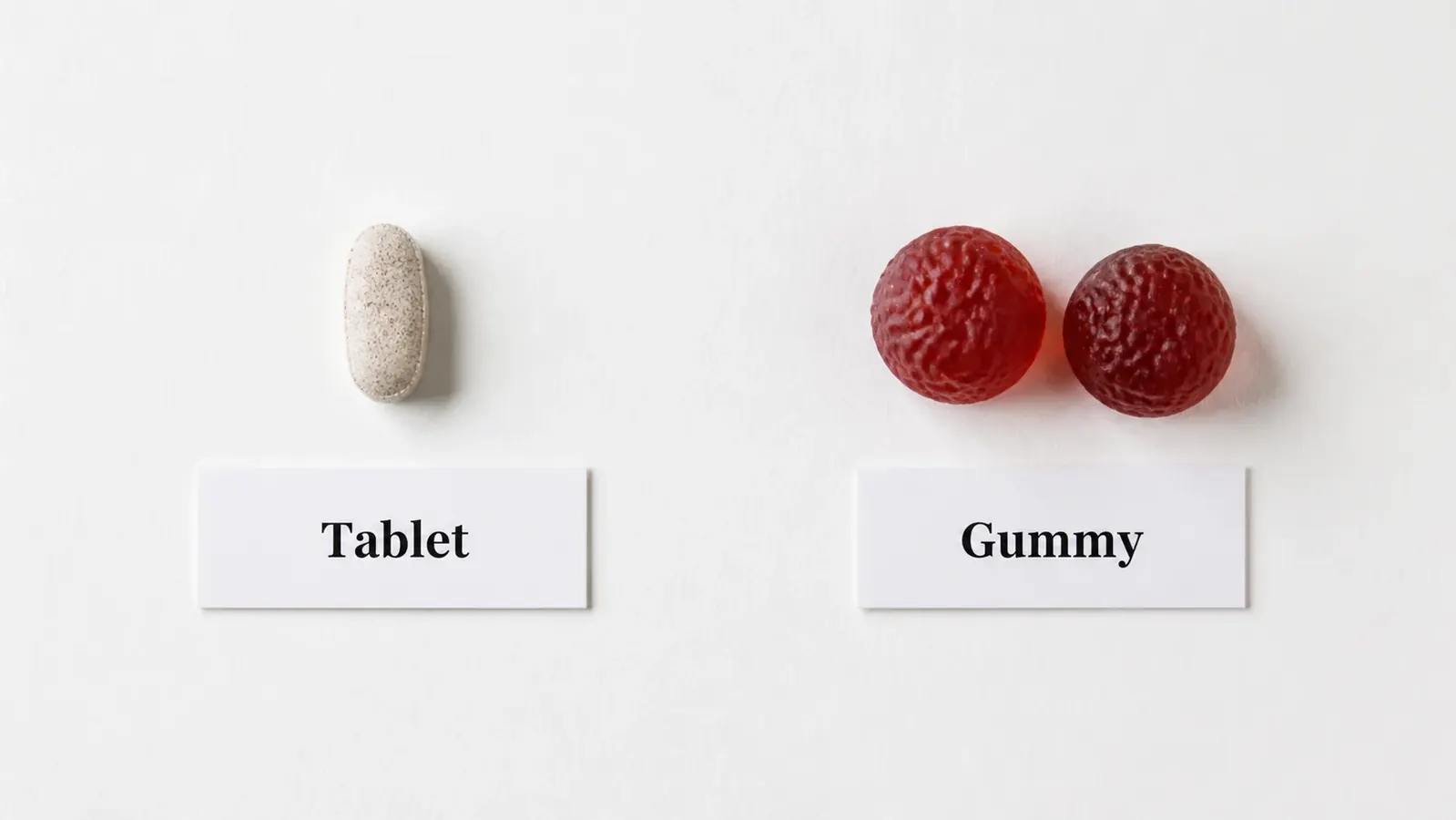
Gummy multivitamins have strong appeal. They taste like candy, they are easy to remember, and they feel less clinical than swallowing a tablet. The problems are real and worth knowing. First, gummies almost universally contain added sugar, typically two to three grams per serving. Over time, for women managing blood sugar or trying to reduce inflammation, that is a quiet source of daily sugar that adds up. Second, gummy formulas routinely exclude minerals because mineral salts do not hold well in a gummy matrix. Calcium, iron, magnesium, and potassium are commonly absent or significantly underdosed. Third, gummies tend to be less stable. The nutrients degrade more quickly after the bottle is opened, particularly fat-soluble vitamins.
If you genuinely cannot tolerate swallowing tablets, a gummy is better than nothing. But compare the supplement facts panels side by side and you will find that a quality tablet formula delivers more complete nutrition. Centrum Silver Women 50+ is a tablet. It is not large. I have had no issue with it.
What Else Helps
A multivitamin is a foundation, not a ceiling. The nutrients most commonly deficient in post-menopausal women, vitamin D, B12, magnesium, and omega-3 fatty acids, may not be fully addressed by any single daily tablet regardless of how well formulated it is. If your diet is rich in fatty fish, leafy greens, dairy, eggs, and nuts, your multivitamin is doing relatively light work. If your diet is more restricted, whether by choice or circumstance, the gaps are larger. A well-chosen multivitamin narrows those gaps; it does not eliminate the need to eat well.
The other thing worth doing is talking to your doctor before you change your supplement routine, particularly if you take any prescription medications. Some vitamins interact with common post-menopausal medications. Vitamin K, for instance, directly counteracts warfarin. High-dose B6 over long periods has its own risks. Your physician can order a basic micronutrient panel if you are uncertain where your actual deficiencies are, rather than guessing from a label. That panel is worth more than any amount of front-of-bottle research.
For a broader look at how post-menopausal nutritional needs shift across multiple nutrients, the article on ten ways menopause changes what your body needs from a multivitamin covers the underlying physiology in more detail. And if you want my longer assessment of how Centrum Silver Women 50+ performed over four months of daily use, that is in the full review.
Centrum Silver Women 50+ Checks the Boxes That Matter at This Price Point
D3, not D2. Zero iron. USP-verified. 200 mg calcium as a top-up, not an overload. B12 at a meaningful dose. The formulation is not perfect, but it is honest about what it is, which puts it ahead of much of the competition on the shelf next to it. The 200-count bottle runs economically at current pricing.
Amazon Check Today's Price on Amazon →