

For about eight years I took the same multivitamin I had been buying since my late thirties. I did not think much about it. It was on the shelf, it was familiar, and I assumed that a multivitamin was a multivitamin. Then my doctor ran a routine blood panel at my annual physical, and my vitamin D came back at 18 ng/mL. Technically not deficient, but well below the 30 to 50 range she wanted for a 56-year-old post-menopausal woman. My B12 was on the low end of normal. She asked what multivitamin I was taking. When I told her, she said, quietly and without drama, that I should probably consider switching to one formulated for my age group. That was the beginning of this particular experiment.
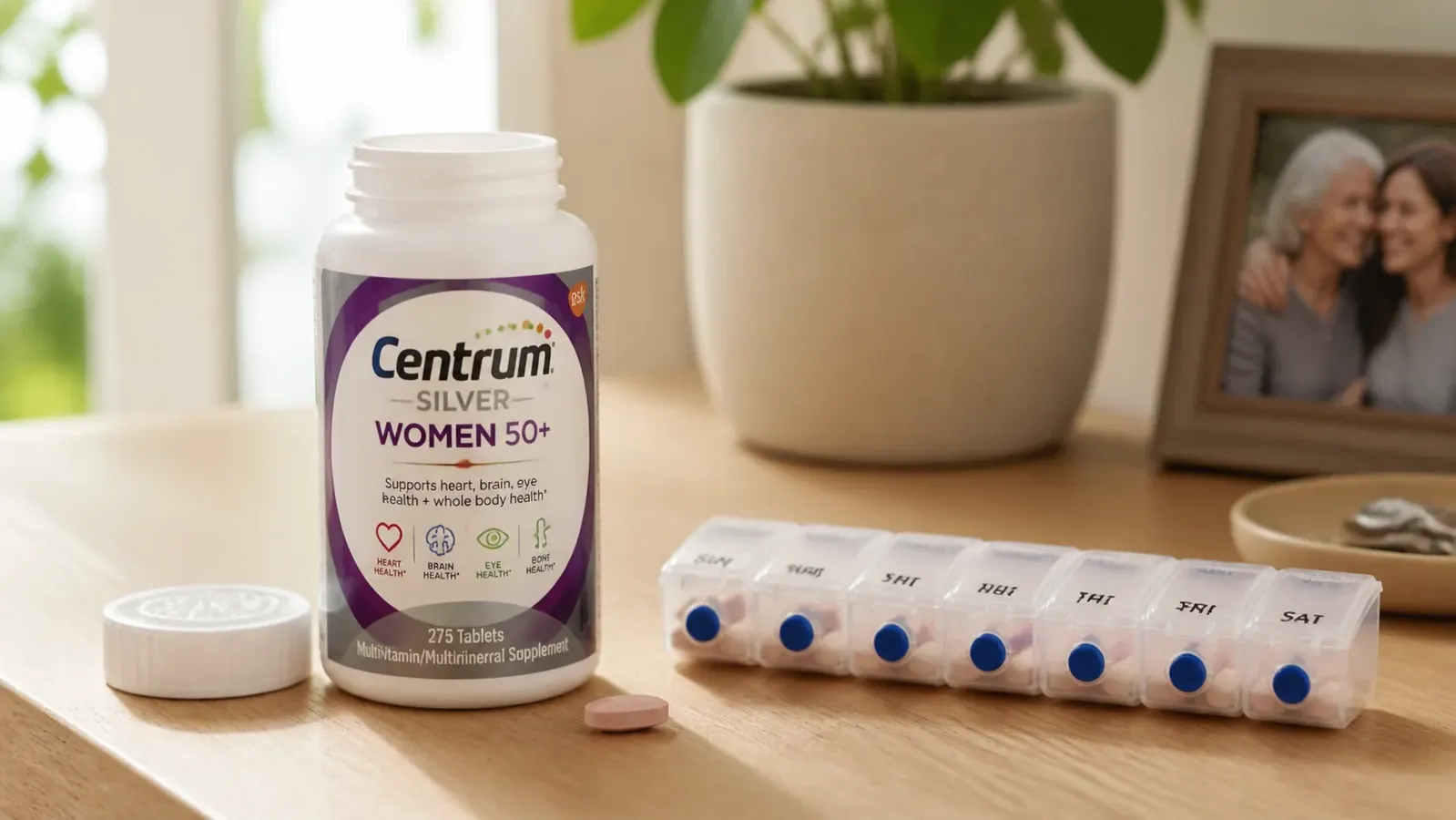
I picked up Centrum Silver Women 50+ and took it every morning for four months, keeping notes on what I noticed and doing my homework on whether the formulation actually reflects what the research says a post-menopausal woman needs. This review covers both: the numbers on the label and the lived experience of taking it. I will also be honest about what a multivitamin cannot do, because that matters as much as what it can.
The Quick Verdict
A sensibly formulated multivitamin that matches post-menopausal nutritional priorities better than most standard adult options. Not a hormone solution, not a cure for midlife fatigue, but a reasonable nutritional baseline for women who want one supplement that covers the gaps most likely to open up after fifty.
Amazon Check Today's Price →Still taking the same multivitamin you used at 38? Your nutritional needs shifted at menopause.
Centrum Silver Women 50+ is formulated specifically for post-menopausal micronutrient priorities: more vitamin D3, more B12, calcium support, and reduced iron. Over 33,000 ratings on Amazon, and available in a 200-count bottle that lasts months.
Amazon Check Today's Price on Amazon →Why I Tested This: What Actually Changes After Menopause
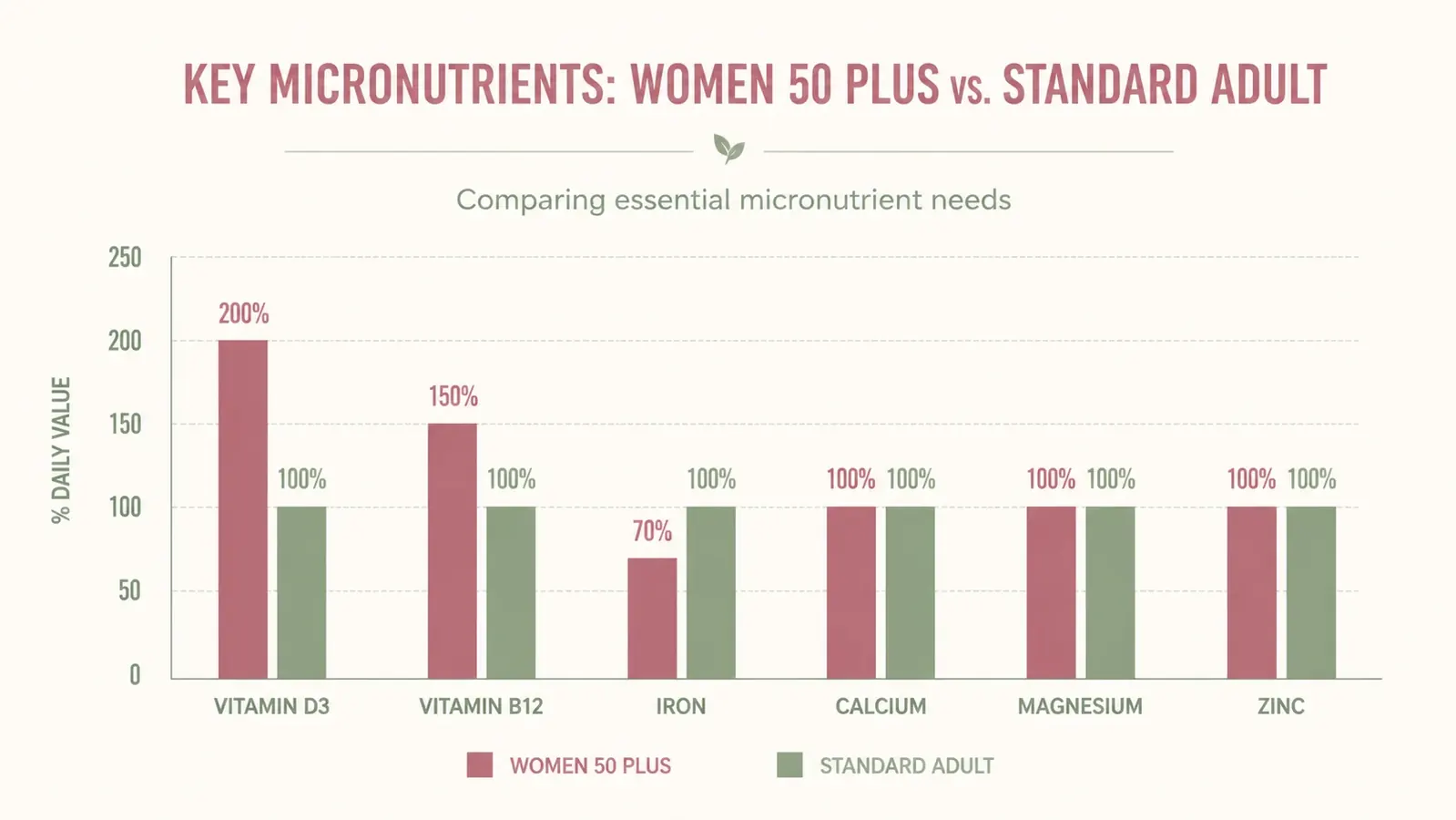
Before I get into the tablet itself, it is worth spending a moment on why the formulation question matters at all. The answer is not marketing. It is physiology. When estrogen levels fall, several things happen that affect how the body handles nutrients. Calcium absorption decreases because estrogen plays a role in activating vitamin D, which in turn drives calcium uptake in the gut. Vitamin D3 needs tend to rise at the same time, because post-menopausal women are at higher risk of deficiency even with adequate sun exposure. B12 absorption becomes less efficient as stomach acid levels decline with age, and low B12 is associated with fatigue and cognitive fog. And iron requirements drop substantially once menstrual cycles end, which means a multivitamin containing full premenopausal iron levels is delivering something you no longer need and may not want.
I spent a few evenings reading through clinical nutrition guidelines and the National Institutes of Health dietary reference intake tables for women over fifty. The picture they paint is fairly consistent: post-menopausal women benefit from higher D3 and B12, need calcium support (though ideally from food where possible), and should not be adding extra iron unless a blood test says otherwise. That framework became my lens for evaluating what Centrum Silver Women 50+ actually delivers.
What Is in the Tablet: A Label Read Without the Marketing
Centrum Silver Women 50+ provides 1000 IU of vitamin D3 per tablet. That is a reasonable starting point, though many post-menopausal women with confirmed deficiency will need a separate D3 supplement to reach therapeutic levels. The form is D3, which is the more bioavailable form, not D2. B12 comes in at 500 mcg, which is generous and accounts for the absorption inefficiency that comes with age. It is listed as cyanocobalamin, the standard synthetic form, which converts adequately in most people though some with absorption issues do better with methylcobalamin. Calcium is present at 210 mg, which contributes to daily needs but is not sufficient on its own. You still need to eat your dairy, leafy greens, or fortified foods.
The iron content is where this formulation distinguishes itself from standard adult multivitamins. Centrum Silver Women 50+ contains no added iron. That is the correct choice for the post-menopausal demographic. Too much iron from supplements is associated with constipation and, in excess, with oxidative stress. The formulation also includes zinc at 8 mg, magnesium at 50 mg (low, but this is a multivitamin not a magnesium supplement), and a reasonable spread of the B-complex vitamins. It is gluten-free and marked non-GMO, which matters to some buyers and is worth noting.
Four Months of Daily Use: What I Noticed
I want to be careful here about causality. A multivitamin taken alongside a reasonably varied diet, adequate sleep, and light daily movement is not an isolated variable. What I can tell you is what I observed across four months, and where the timing felt relevant.
In the first six weeks, nothing dramatic. The tablet is small enough to swallow comfortably, which matters because some multivitamins at this size are genuinely difficult. No nausea, no digestive discomfort. I took it with breakfast, which the label recommends, and I noticed no aftertaste. Energy levels during this period felt about the same as baseline. I was not expecting a surge and I did not get one.
A multivitamin is not a cure for the hormonal landscape of menopause. Anyone who tells you otherwise is selling something other than a vitamin.
By weeks seven through ten, something I did notice was a slight steadying of my afternoon energy dip. I tend to hit a wall around two in the afternoon, which my GP attributes partly to a disrupted sleep architecture that is common in the early post-menopausal years. The wall did not disappear, but it felt less steep. I cannot attribute that with certainty to the B12 content, but B12 is associated with energy metabolism and I had been borderline low, so the connection is at least plausible. My follow-up blood panel at month three showed my B12 had moved from the low end of normal to mid-range, which was the clearest measurable signal from this experiment.
Skin felt more consistent across the four months, which I noticed mainly in terms of what did not happen: I did not get the periodic dry, tight patches on my jawline and temples that I had been dealing with intermittently. Whether that is the vitamin D, the zinc, or simply seasonal change, I cannot say with confidence. Skin in midlife is sensitive to so many variables that I am reluctant to give the multivitamin full credit. But I noticed it and it is worth including.
Sleep quality is the one area where I noticed no meaningful change. If you are struggling with sleep in the post-menopausal years, a multivitamin will not fix it. The research on magnesium and sleep is more interesting, but Centrum Silver Women 50+ contains only 50 mg of magnesium, which is far below the amounts used in sleep studies. If sleep is your main concern, this is not the supplement to expect results from.
Compared to Getting Nutrients From Food
I want to address this honestly because I think it matters. The research on supplementation is fairly clear that food-sourced nutrients are generally better absorbed and used than their supplement counterparts. Whole food sources of vitamin D, calcium, B12, and antioxidants come packaged with cofactors, fiber, and compounds that supplements do not replicate. If you are eating an excellent, varied diet with oily fish twice a week, a lot of leafy greens, dairy or fortified plant alternatives, and regular sun exposure, you may find a multivitamin adds less than you expect.
The more honest use case for a supplement like this is as a nutritional safety net, not a replacement strategy. Most of us do not eat perfectly every day, and the older we get, the less margin we have for nutritional inconsistency, particularly around the nutrients that post-menopausal physiology makes harder to absorb efficiently. That is the honest role of a multivitamin: catching what a decent but imperfect diet misses. Centrum Silver Women 50+ does that job competently, without pretending to be more than it is.
What I Liked
- Formulation matches post-menopausal nutritional priorities: elevated D3 and B12, no added iron
- Small tablet that swallows comfortably without a large glass of water
- No digestive discomfort at standard one-tablet dose
- Gluten-free and non-GMO, which matters for buyers with sensitivities
- 200-count bottle offers a long supply at a reasonable per-tablet cost
- B12 at 500 mcg is a meaningful dose given age-related absorption decline
Where It Falls Short
- Magnesium at 50 mg is low, not sufficient for sleep or muscle function support
- B12 is cyanocobalamin rather than methylcobalamin, which may matter for some people
- Calcium at 210 mg is a contribution, not a complete solution. Food remains essential
- Vitamin D3 at 1000 IU may be insufficient for women with diagnosed deficiency
- Folic acid is in the synthetic form, which some researchers flag as less appropriate for older women compared to methylfolate
What This Is Not
A multivitamin is not a hormone solution. If you are managing significant menopausal symptoms, hot flashes, severe sleep disruption, mood instability, or the cognitive fog that some women describe in perimenopause, those are conversations for your doctor and potentially for HRT or other targeted interventions. Centrum Silver Women 50+ will not address any of that. Anyone marketing a multivitamin as a menopause remedy is stretching well past what the evidence supports, and I would be skeptical.
It is also not a substitute for the targeted supplements that some women need individually. If your D3 is clinically low, you likely need a separate D3 supplement at a therapeutic dose. If your B12 is severely deficient, sublingual methylcobalamin may work better for you. If you want meaningful magnesium support for sleep or muscle recovery, a dedicated magnesium supplement is a better path. This tablet is a baseline, not a complete picture.
Who This Is For
This multivitamin suits a post-menopausal woman who eats reasonably well but wants a daily nutritional safety net that reflects the actual physiology of her age group. It works well as a first step after realizing your previous multivitamin was formulated for a younger demographic. It is also a good fit if you want simplicity: one tablet, one habit, covering the major gaps without requiring you to manage a shelf full of individual supplements. If your bloodwork is in reasonable order and you are looking for a sensible, unglamorous baseline, this is it.
Who Should Skip It
If you have confirmed vitamin D deficiency, a 1000 IU multivitamin contribution is unlikely to move your levels meaningfully and you will need a standalone D3 supplement regardless. If you have the MTHFR gene variant and your doctor has recommended methylfolate specifically, you should check whether synthetic folic acid is appropriate for you before committing to this. If your primary reason for wanting a multivitamin is sleep support, look elsewhere or consult a practitioner about magnesium glycinate as a separate supplement. And if your diet is already excellent and your blood panels consistently show no gaps, the honest answer is that you may not need a multivitamin at all.

A post-menopausal baseline that actually fits your biology, not your 38-year-old self's.
Centrum Silver Women 50+ is the most straightforward switch I can recommend if you are still taking a standard adult multivitamin after menopause. The formulation is sensible, the price per tablet is low, and the 200-count bottle keeps the habit simple. Worth checking the current price before you restock whatever you have been taking.
Amazon Check Today's Price on Amazon →