
Most post-menopausal women are still taking the same multivitamin they picked up at 42. The formula worked then. The problem is that your body at 52 has genuinely different requirements: lower iron needs, declining B12 absorption tied to stomach acid changes, and a much higher demand for vitamin D3 than any general-adult formula delivers. Centrum Silver Women 50+ was designed around those specifics. One A Day Women's 50+ Healthy Advantage was not, quite, and the label tells the story if you know where to look.
I want to say upfront that neither of these is a bad product. One A Day is a reputable brand with a long track record. But when I sat down with both labels and compared them nutrient by nutrient, Centrum Silver came out ahead on the markers that matter most after menopause. Here is the full breakdown, including the few places where One A Day holds its own.
| Attribute | Centrum Silver Women 50+ | One A Day Women's 50+ |
|---|---|---|
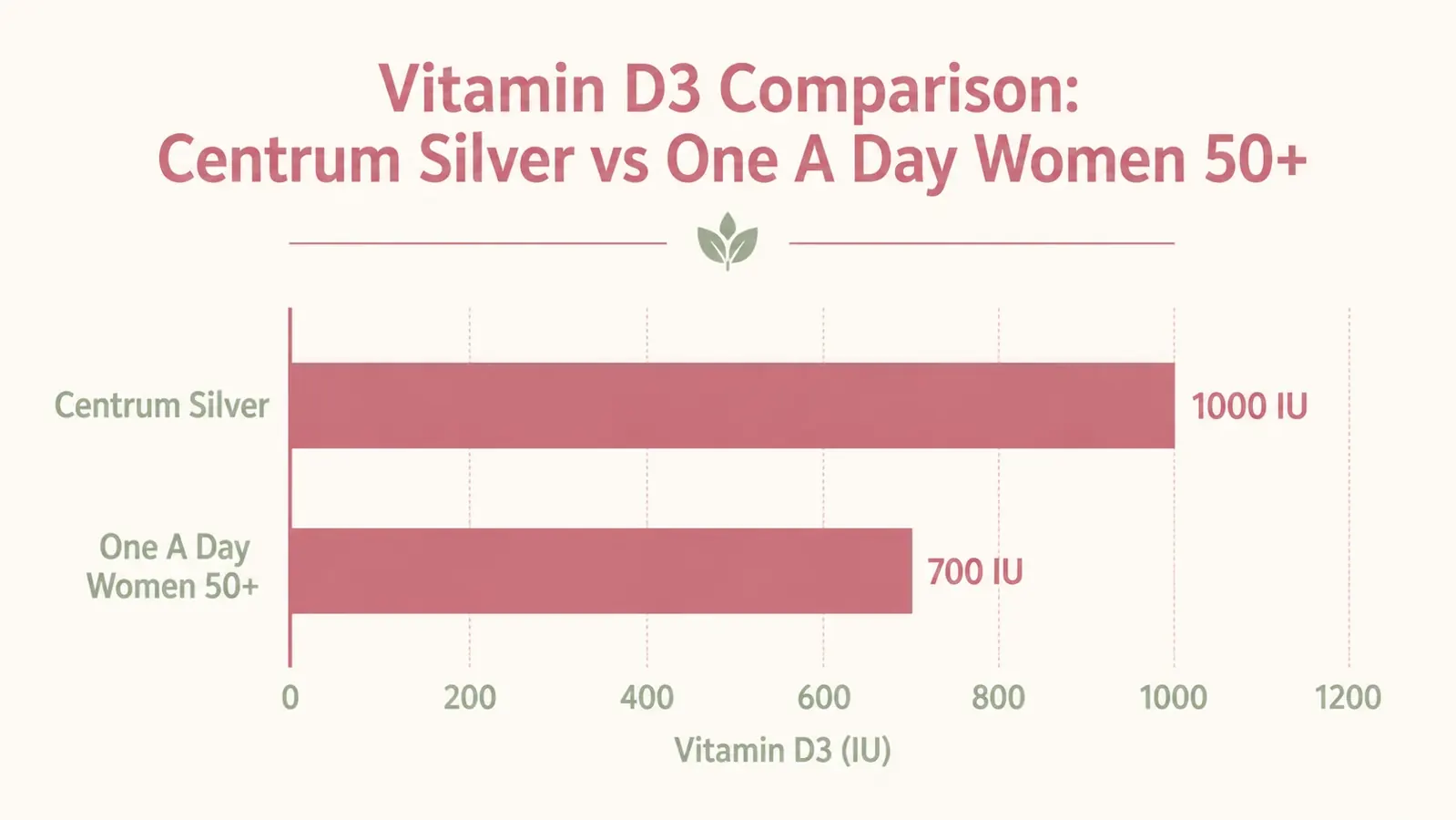
| Vitamin D3 dose | 1000 IU (25 mcg) | 700 IU (17.5 mcg) |
| B12 form | Cyanocobalamin | Cyanocobalamin |
| B12 dose | 25 mcg | 25 mcg |
| Calcium | 210 mg | 320 mg |
| Magnesium | 50 mg | 50 mg |
| Iron | 0 mg (none) | 8 mg |
| Lutein | 300 mcg | Not included |
| Lycopene | Not included | Not included |
| K2 (menaquinone) | Not included | Not included |
| Omega support | None | None |
| Third-party tested | USP verified | Not USP verified |
| Price per tablet (approx) | Moderate cost | Mid-range |
| Tablets per bottle (typical) | 200 | 65-100 |
| Amazon ASIN | B09KCCVL9V | No ASIN listed |
Where Centrum Silver Wins
The vitamin D3 difference is the one I notice first on any 50-plus multivitamin label. Centrum Silver delivers 1000 IU, which is at the lower end of what most endocrinologists currently suggest for post-menopausal women but still meaningfully above One A Day's 700 IU. After menopause, estrogen decline accelerates bone mineral loss, and vitamin D3 is the gating factor for calcium absorption. You can take all the calcium you want and very little of it makes it into your bones without adequate D3. The 300 IU difference between these two bottles is not trivial.
The iron situation is where Centrum Silver makes the clearest age-appropriate call. It contains zero iron. One A Day includes 8 mg. Before menopause, monthly blood loss creates a real need for dietary iron supplementation. After menopause, that need largely disappears, and excess iron at that stage is associated with increased oxidative stress and, in some research, cardiovascular risk. One A Day's 8 mg iron is not a disaster for a post-menopausal woman, but it is a formulation choice that looks like it was not updated for this age group. Centrum Silver's zero-iron approach is the correct one for women who have passed menopause.
Centrum Silver also includes 300 mcg of lutein. One A Day does not include it at all. Lutein is a carotenoid associated with macular health, and the evidence for its role in reducing age-related macular degeneration risk is stronger than for almost any other supplement category. Eyes change in your fifties. Adding lutein to a multivitamin designed for this age group is a thoughtful formulation choice. It is also not expensive to include, which makes its absence in One A Day harder to explain.
Finally, Centrum Silver is USP verified. That small seal on the label means an independent organization has tested the product for purity, potency, and dissolution. You are getting what the label says. One A Day is not USP verified. That does not mean the product is inaccurate, but it means you are taking the manufacturer's word for it. For a supplement you take every day, that distinction is worth something.
Still Taking a Pre-Menopause Multivitamin? The Formula That Actually Fits Your Fifties Is Here.
Centrum Silver Women 50+ addresses the specific gaps that open up after menopause: higher D3, zero iron, added lutein, and USP-verified purity. It is the top-selling multivitamin for women over 50 for reasons that hold up when you read the label.
Amazon Check Today's Price on Amazon →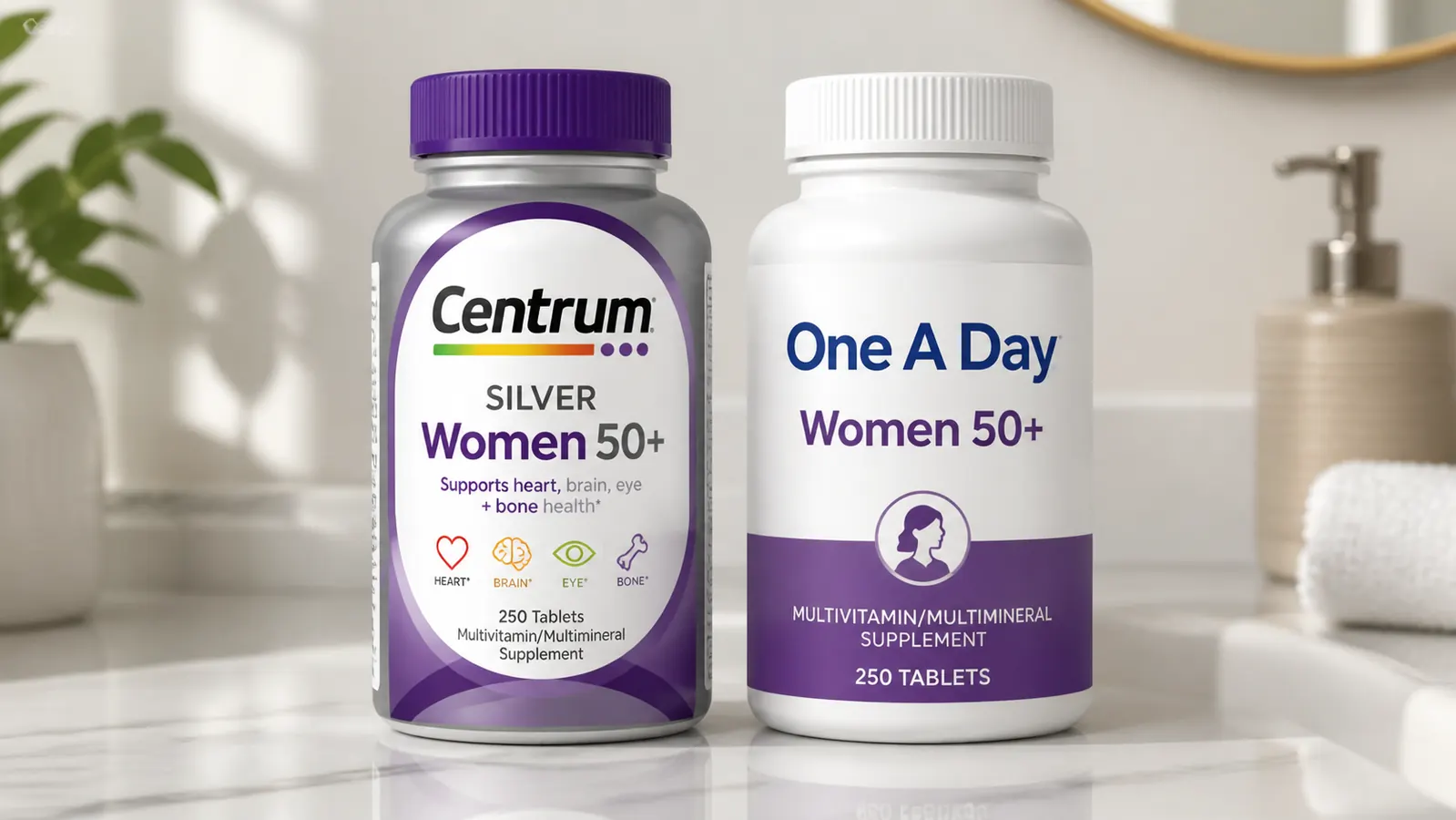
Where One A Day Wins
One A Day delivers more calcium per tablet: 320 mg versus Centrum Silver's 210 mg. Calcium matters post-menopause, and if a woman is not getting adequate amounts from dairy, fortified foods, or a separate supplement, that additional 110 mg is meaningful. I would still argue the D3 gap largely offsets this advantage since calcium without sufficient D3 to aid absorption is only partly useful. But it is a fair counterpoint if someone is calcium-deficient and not supplementing separately.
One A Day also includes omega fatty acids in some of its product variants, which Centrum Silver does not. I want to be careful here: the specific SKU most widely sold for women over 50 in the One A Day line does not consistently include omega support, and the dose when present tends to be nominal. If omega-3s are a priority, a dedicated fish oil capsule is a more reliable approach than relying on a multivitamin to deliver them. Still, if someone is looking at a single-pill solution and happens to find a One A Day variant with omegas included, that is an edge.
The iron is the tell. A multivitamin that includes 8 mg of iron for post-menopausal women is a formula written for a younger body. That one ingredient tells me the label was not rethought for this life stage.
A Closer Look at B12: Where Both Products Have Limitations
Both products use cyanocobalamin as their B12 form. This is the most common and least expensive form of B12, and it is reasonably well absorbed in most people. However, some individuals, particularly those with the MTHFR gene variant or reduced gastric acid (which becomes more common with age), absorb methylcobalamin more efficiently. Neither Centrum Silver nor One A Day addresses this. If you have had bloodwork showing low B12 despite taking a multivitamin for years, switching to a methylcobalamin-based standalone B12 supplement is worth a conversation with your doctor. Both products deliver 25 mcg per tablet, which is adequate for most women who have no absorption issues.
The same honest caveat applies to calcium form. Both products use calcium carbonate, which requires stomach acid for absorption and is ideally taken with food. Calcium citrate absorbs better on an empty stomach and in women with lower stomach acid, which is more prevalent after 50. Neither of these multivitamins is the right vehicle for a full calcium supplement dose in any case: the amounts are too low to replace a dedicated calcium supplement if you need one. Think of the calcium in either product as supplementary to what you get from food, not a replacement.
Price and Practicality
Centrum Silver's 200-count bottle typically works out to roughly the lower end per tablet. One A Day's smaller bottles land closer to the higher end per tablet at comparable retailers. That gap matters if you take a multivitamin every day for years. The price difference is not the primary reason to choose Centrum Silver, but it does not hurt that the better-formulated product for this age group also happens to cost less per dose.
Neither product requires refrigeration. Both are coated tablets that most women I know find easy to swallow. Centrum Silver tablets are slightly smaller, which some people appreciate. Neither has a strong smell or causes nausea when taken with breakfast, which is the most common complaint about iron-containing multivitamins. That is another indirect benefit of Centrum Silver's zero-iron formula.

What Neither Product Does
I want to be clear about the gaps in both formulas because I think the supplement aisle oversells what a standard multivitamin can accomplish. Neither Centrum Silver nor One A Day includes vitamin K2 in the menaquinone-7 (MK-7) form, which is the form most associated with directing calcium toward bone rather than soft tissue. Neither includes meaningful magnesium: both deliver 50 mg, far below the 300-400 mg daily reference range. Neither includes collagen-supporting nutrients at therapeutic doses. If bone density is a serious concern, neither of these multivitamins replaces a dedicated vitamin D3 plus K2 supplement taken alongside a magnesium glycinate capsule. A standard multivitamin is a nutritional foundation, not a treatment program.
The honest advice is this: take whichever you choose with food, at the same time each day, alongside a diet that covers the heavy lifting. Leafy greens, fatty fish, fermented dairy, and reasonable sunlight exposure do more for post-menopausal nutritional status than any pill can. The multivitamin fills the gaps. It does not replace the diet.
Who Should Buy Which
Buy Centrum Silver Women 50+ if you are post-menopausal, have no current menstrual cycle, and want the formulation that has been specifically calibrated for this life stage. The zero-iron formula, the higher D3 dose, the lutein inclusion, and the USP verification are all the right calls for this demographic. It is also the better value per tablet. This is the product I take, and it is the one I would recommend to most women in their fifties without hesitation.
Consider One A Day Women's 50+ if you are in perimenopause and still have irregular cycles, meaning you may still need some dietary iron support. The higher calcium content is also a minor point in its favor if you are not supplementing calcium separately and your dietary intake is low. I would still lean toward Centrum Silver and add a dedicated calcium-magnesium supplement if needed, but I recognize that some women prefer a single-pill approach even if the tradeoffs are imperfect.
Both products are available on Amazon with Subscribe and Save options that reduce the per-tablet cost further. If you are taking either of these daily, the subscription pricing makes sense. Centrum Silver's 200-count bottle in particular offers good value at Subscribe and Save rates.
The Numbers Favor Centrum Silver. Here Is How to Get It.
Higher D3, zero iron, added lutein, USP-verified purity, and the lowest price per tablet of the two. Centrum Silver Women 50+ is the clear choice for most post-menopausal women, and the 200-count bottle means you won't be back at the supplement aisle every six weeks.
Amazon Check Today's Price on Amazon →